
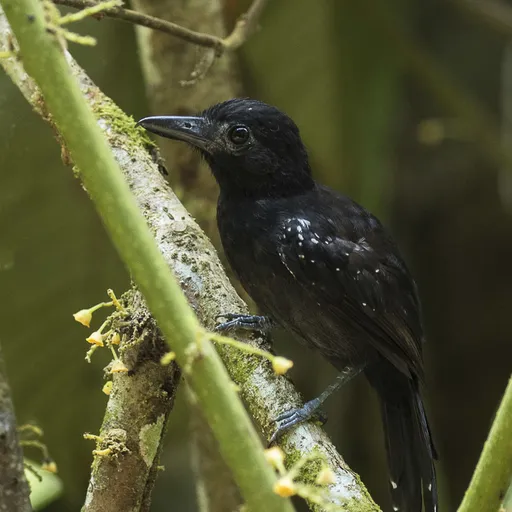
Black-hooded Antshrike
Thamnophilus bridgesi
Least Concern
Overview
The black-hooded antshrike (Thamnophilus bridgesi) is a species of bird in the family Thamnophilidae, commonly known as the typical antbirds. It is found exclusively in the Pacific lowlands of Costa Rica and Panama and is currently classified as Least Concern by the IUCN.
Identification
- Adults exhibit sexual dimorphism: males are mostly black with a white patch between the scapulars, small white dots on wing coverts, and a dark gray belly; females have blackish gray heads with narrow white streaks, dark grayish brown upperparts, and olive underparts with white streaks.
- Measuring 15 to 17 cm in length, this species possesses a stout bill with a hook resembling those of true shrikes.
- The song is described as an accelerating series of staccato notes ending in a longer, lower note, or as a high wooden 'wekwekwekkerwikkerwek' that varies in speed and length.
Habitat
Found on the Pacific slope from southern Guanacaste Province in Costa Rica to Los Santos Province in western Panama, the species inhabits the edges of lowland evergreen, semi-deciduous, and gallery forests, as well as taller secondary woodland and mangroves. It generally occupies the understorey to mid-storey, favouring shrubby areas and vine tangles, and mostly occurs below 1,000 m but ranges up to 1,200 m in Costa Rica.
Diet
The diet consists of a variety of insects and other arthropods, including spiders. It usually forages singly or in pairs, often joining mixed-species flocks, and moves sluggishly through dense vegetation to glean prey with quick stabs and lunges. In drier areas, it commonly forages on the ground by probing and flipping leaf litter, and occasionally follows army ant swarms to capture fleeing prey.
Did you know?
Although the nest is constructed from fine rootlets and fibers and decorated with green moss, it is typically attached to a branch fork by its rim using cobwebs.
Sources
- Wikipedia · CC BY-SA 4.0
- Wikidata · CC0 1.0