
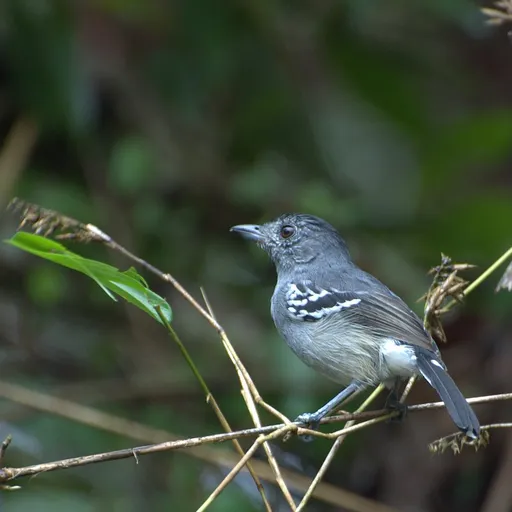
Variable Antshrike
Thamnophilus caerulescens
Least Concern
Overview
The variable antshrike (Thamnophilus caerulescens) is a species of antbird in the family Thamnophilidae, known for possessing the most variable plumage among antbirds. It is found across a broad range in South America, including Argentina, Bolivia, Brazil, Paraguay, Peru, and Uruguay. Classified as Least Concern by the IUCN, the species is considered fairly common across most of its range despite a believed decreasing population.
Identification
- Adults exhibit significant sexual dimorphism; males of the nominate subspecies have black crowns and napes with grey faces, while females have olive-brown crowns and cinnamon-tawny underparts.
- The species is 14 to 16 cm long and weighs between 15 and 24 g, featuring a stout, hooked bill similar to that of true shrikes.
- The song is described as a simple countable series of usually 6–7 plaintive, evenly spaced whistles of the same pitch, often transcribed as 'nyah nyah nyah nyah' or 'au-au-au-au'.
- While foraging, the bird is regularly observed 'dipping' its tail and flicking its wings.
Habitat
The variable antshrike inhabits a variety of landscapes, including evergreen forest, secondary woodland, and thickets in open areas, generally favouring edges over forest interiors. It shuns arid habitats and occurs in humid forests in the Andes at elevations between 1,200 and 2,800 m, while in the Gran Chaco it occupies dense shrubs and low woodlands along watercourses. A non-contiguous subspecies, T. c. cearensis, is restricted to the Atlantic Forest in northeastern Brazil.
Diet
The diet consists mostly of insects and other arthropods, with small amounts of seeds and fruits. It forages singly or in pairs, usually in the understorey to mid-storey, and often joins mixed-species feeding flocks or follows army ant swarms. The bird hops and creeps through vegetation, gleaning prey by reaching and lunging from perches, and has been observed dropping to pick prey from leaf litter.
Did you know?
The species' adaptation to edge habitats, second-growth woodland, and other human-created environments makes it less sensitive to disturbance than many of its relatives. However, the conservation of the cearensis subspecies is of concern because the humid forest within its range has been largely reduced to remnant patches surrounded by sugar cane and other large-scale agricultural development.
Sources
- Wikipedia · CC BY-SA 4.0
- Wikidata · CC0 1.0