
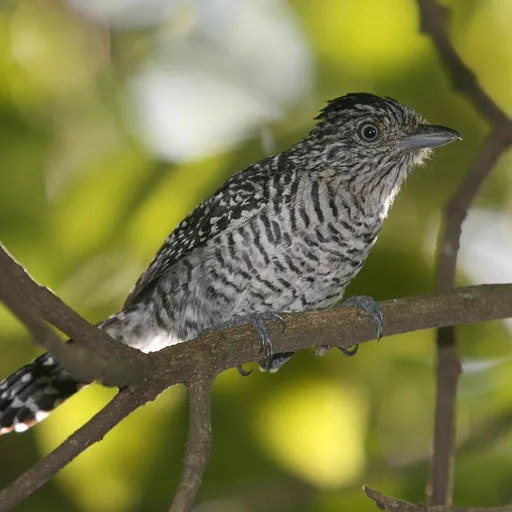
Barred Antshrike
Thamnophilus doliatus
Least Concern
Listen
XC248770 · Niels Krabbe · Orellana: river island at Añangu, Ecuador · CC BY-SA 4.0
Overview
The barred antshrike, Thamnophilus doliatus, is a passerine bird belonging to the family Thamnophilidae, often classified among the 'typical antbirds'. It is classified as a species of Least Concern by the IUCN, with an estimated population of at least 50 million mature individuals that is currently stable.
Identification
- Length of 15 to 18.5 cm and a weight of 24 to 32 g, featuring a stout bill with a hook similar to true shrikes.
- Adult males display alternating black and white bars across their plumage, with thicker black bars on the upperparts and thinner black bars on the underparts.
- Adult females possess cinnamon-rufous crests and upperparts, with black and white streaks on the sides of the head and neck.
- Song consists of a long series of loud chuckling or cackling notes that rapidly ascend in intensity before descending to an emphatic final note.
Habitat
Found in the Neotropics across Mexico, Central America, Trinidad and Tobago, and most of South America, with one accepted record in southern Texas. The species favours thick undergrowth, scrublands, riparian thickets, and secondary forest, often shunning the interior of mature forests. In eastern Colombia and parts of the Amazon, it is frequently found on river islands.
Diet
The barred antshrike has a cosmopolitan diet consisting primarily of mature and larval insects, along with other arthropods, small lizards, fruit, and seeds. It typically forages in pairs within dense foliage, employing rapid stabbing motions to glean prey from leaves and stems, and occasionally feeds on prey fleeing army ant swarms.
Did you know?
The species constructs nests that are tightly woven but thin-walled open cups, typically suspended by their rim from a branch fork. Both sexes participate in building the nest, and while both incubate during the day, only the female performs this duty at night.
Sources
- Wikipedia · CC BY-SA 4.0
- Wikidata · CC0 1.0