
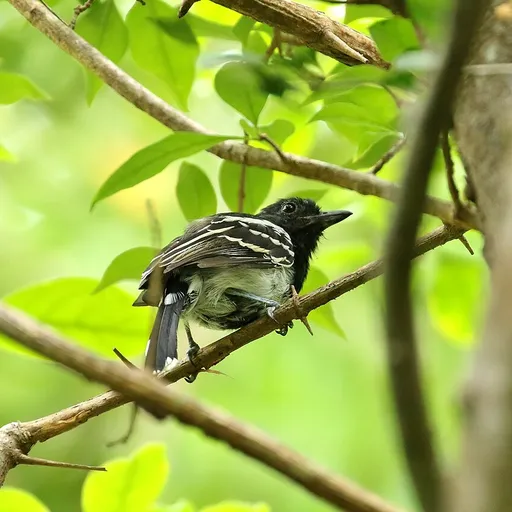
Black-backed Antshrike
Thamnophilus melanonotus
Least Concern
Overview
The black-backed antshrike is a species of bird in the family Thamnophilidae, the typical antbirds. It is classified as Thamnophilus melanonotus and is found in Colombia and Venezuela.
Identification
- Measures 15 to 16 cm in length and possesses a stout, hook-tipped bill.
- Adult males feature a black to blackish brown head and back, a light gray rump, and black wings with wide white tips, contrasted by black throats and white flanks and belly.
- Adult females have a dark brown crown with cinnamon edges, a buff face, and brownish-black wings with pale buff edges.
- Vocalisations include a soft "cuua" and a short, nasal roll, as well as grunts and soft nasal calls.
Habitat
The species inhabits the understorey to mid-storey of dry deciduous forests, favouring dense vine thickets. It is found from sea level to 1,000 m in Colombia and up to 1,300 m in Venezuela, though predominantly below 500 m in the latter. Its distribution is disjunct, covering parts of the Caribbean slope and the Zulia River valley.
Diet
Its diet consists primarily of insects and likely other small arthropods. It forages lethargically, mostly singly or in pairs, on and near the ground up to 6 m high, often within vine tangles. Feeding methods include gleaning, short upward jumps, pouncing, and occasionally following army ant swarms.
Did you know?
The species' genus classification has shifted historically; it was moved to Sakesphorus but returned to Thamnophilus after a 2007 molecular study found the former to be polyphyletic. Its one known nest was an open cup suspended in a branch fork containing two eggs.
Sources
- Wikipedia · CC BY-SA 4.0
- Wikidata · CC0 1.0