
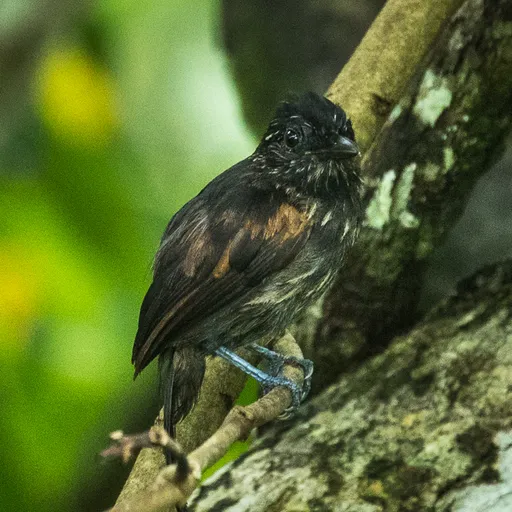
Black Antshrike
Thamnophilus nigriceps
Least Concern
Overview
The black antshrike (Thamnophilus nigriceps) is a species of insectivorous bird in the family Thamnophilidae, commonly known as the typical antbirds. It is classified as a species of Least Concern by the IUCN Red List, with an estimated population of 20,000 to 50,000 mature individuals.
Identification
- Males are almost entirely black, featuring dark gray flanks and white underwing coverts, while females have a blackish gray head and breast with rufous-brown upperparts and buff-white streaks.
- The species measures 15 to 16 cm in length and weighs between 23 to 24 g, possessing a stout bill with a hook similar to those of true shrikes.
- Vocalisations include a moderately long, slightly accelerating series of musical yet emphatic notes, along with hollow nasal notes and nasal growls.
Habitat
Found in Panama and northern Colombia, this bird primarily inhabits the edges and regrowing clearings of evergreen forest, as well as secondary forest and semi-open woodlands. It shows a strong preference for dense thickets of vines, thorns, and Heliconia, living at elevations ranging from sea level to 600 m.
Diet
The diet is assumed to consist of insects and other arthropods, though specific details are not fully known. The bird forages singly or in pairs within dense vegetation, typically within 2 m of the ground but occasionally up to 7 m high, and hops among branches to glean prey.
Did you know?
Despite its scientific classification, the black antshrike is considered poorly known by researchers, who suggest it may be better categorised as Data-deficient than Least Concern.
Sources
- Wikipedia · CC BY-SA 4.0
- Wikidata · CC0 1.0