
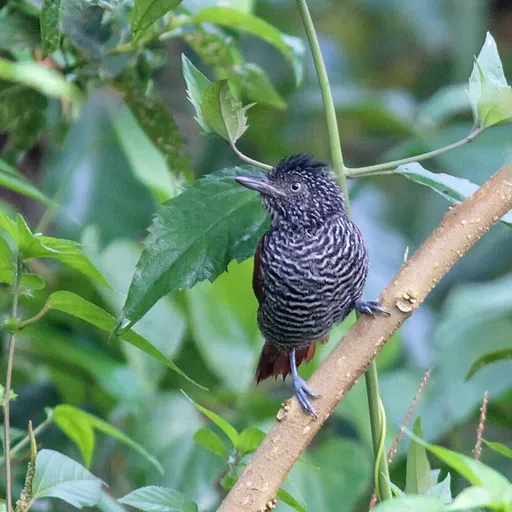
Chestnut-backed Antshrike
Thamnophilus palliatus
Least Concern
Overview
The chestnut-backed antshrike (Thamnophilus palliatus) is a species of bird in the family Thamnophilidae, commonly known as the typical antbirds. It is classified as Least Concern by the IUCN due to its large range and adaptation to various habitats.
Identification
- Size: Approximately 16 to 17 cm long with a weight of 26 to 28 g.
- Plumage: Both sexes have crests; adult males feature a black crown and face with white spots, rufous-brown upperparts, and barred black and white underparts with rufous flanks. Females resemble males but possess a deep rufous-brown crown and wider white bars.
- Bill: Stout with a hook at the tip, similar to true shrikes.
- Vocalisation: Song consists of a moderately long, accelerating series of nasal notes that rise slightly then fall, often written as kah kah-kah-kah-ka'ka'ka'kaka'pah. Calls include an emphatic short nasal note and a longer, upward-inflected squeal.
Habitat
Found in Bolivia, Brazil, and Peru, this species inhabits a variety of somewhat open landscapes, including evergreen forest edges, mature secondary forest, regrowing clearings, and abandoned plantations with bamboo. In the Peruvian Andes, it occupies elevations between 400 and 1,700 m, while in southeastern Brazil it typically stays below 300 m but can reach up to 1,000 m.
Diet
The diet consists of insects and other arthropods such as spiders. Foraging occurs singly or in pairs, often joining mixed-species flocks, within dense vegetation from near the ground to 15 m above. It gleans prey using quick stabs and lunges from leaves, stems, branches, and trunks, and has been observed following army ant swarms in eastern Brazil.
Did you know?
The nest is a small, deep cup loosely woven from fungus, root, and other plant fibers, sometimes covered with green moss and hung by its rim in a branch fork. It is considered highly adaptable, thriving even in highly disturbed woodland and second growth, which renders it of low vulnerability.
Sources
- Wikipedia · CC BY-SA 4.0
- Wikidata · CC0 1.0