
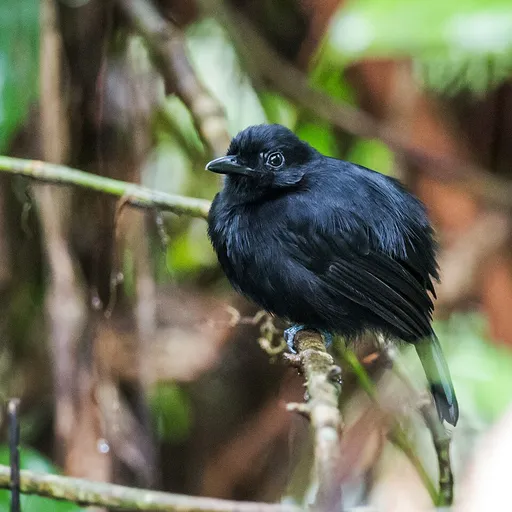
Cocha Antshrike
Thamnophilus praecox
Near Threatened
Overview
The cocha antshrike, Thamnophilus praecox, is a Near Threatened species of typical antbird found in northeastern Ecuador, adjacent Colombia, and northern Peru. It is a monotypic species that is sister to the black antshrike and is currently classified as Near Threatened by the IUCN due to a decreasing population and limited range.
Identification
- Adult males are entirely black, while females have a black head, throat, and upper breast with faint white streaks on the throat and cinnamon-rufous wings, tail, and body.
- Approximately 16 cm long with a stout, hook-tipped bill similar to true shrikes.
- Song consists of a hollow, evenly paced 'ko-ko-ko-ko' sequence, sometimes followed by a shorter, higher-pitched version, along with calls like 'pwow-pwow' and 'krrrrrr'.
Habitat
The species inhabits seasonally flooded várzea forest along small blackwater rivers, favouring dense thickets and tangles at elevations between 160 and 300 m. Its range is restricted to areas along the Río Napo and its tributaries in Ecuador, with disjunct populations in Colombia and northern Peru.
Diet
Although the exact diet is unknown, it is assumed to consist of insects and other arthropods. The bird forages singly or in pairs within dense vegetation, hopping among branches to glean prey and rarely joining mixed-species feeding flocks.
Did you know?
Despite being described in 1937, the cocha antshrike was known only from the holotype specimen until its rediscovery in 1990 near the original collection site.
Sources
- Wikipedia · CC BY-SA 4.0
- Wikidata · CC0 1.0