
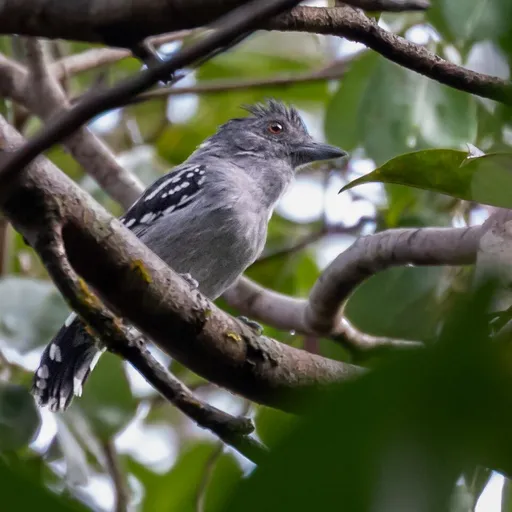
Northern Slaty Antshrike
Thamnophilus punctatus
Least Concern
Overview
The northern slaty antshrike (Thamnophilus punctatus) is a species of typical antbird found in South America. It was previously part of a larger species complex known as the slaty antshrike before being split into six distinct species in 1997. The species comprises four subspecies, with the nominate subspecies having the largest distribution.
Identification
- Length is 13 to 15 cm with a weight of 16 to 18 g, possessing a stout, hook-tipped bill similar to true shrikes.
- Significant sexual dimorphism is observed; adult males of the nominate subspecies feature a grey forehead, black crown, and slaty grey underparts, while females have a tawny crown and yellowish olive-brown upperparts.
- Males display black wings with white spots and edges, whereas females have dark brown wings with white-spotted coverts and buffy edges on flight feathers.
- The song is described as an accelerating series of 10 to 15 progressively shorter notes, starting slowly and rising in pitch, transcribed as "oank, oank, ank, ank, ank, ank-ank-ankank".
Habitat
The bird has a disjunct distribution across Brazil, Colombia, Ecuador, French Guiana, Guyana, Peru, Suriname, and Venezuela. It inhabits a variety of forested and wooded landscapes, favouring the understorey to mid-storey in mature or secondary forests, semi-open woodlands, and dryish deciduous woodlands. Elevations vary by region, ranging from sea level to 1,500 m in Venezuela and up to 1,200 m in Peru.
Diet
The diet consists of insects and other arthropods, though it has not been detailed extensively. Foraging usually occurs singly or in pairs, sometimes joining mixed-species flocks, within 1 to 6 m of the ground. It gleans prey from perches or with short upward sallies, occasionally flipping leaves on the ground and following army ant swarms.
Did you know?
The species was renamed from the slaty antshrike to the northern slaty antshrike following a 1997 study that split the original complex into six species to avoid taxonomic confusion.
Sources
- Wikipedia · CC BY-SA 4.0
- Wikidata · CC0 1.0