
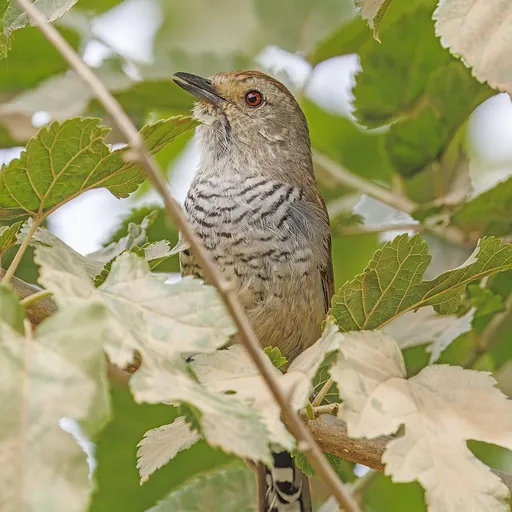
Rufous-capped Antshrike
Thamnophilus ruficapillus
Least Concern
Overview
The rufous-capped antshrike (Thamnophilus ruficapillus) is a bird belonging to the family Thamnophilidae, commonly known as the typical antbirds. It is found across parts of South America, including Argentina, Bolivia, Brazil, Paraguay, Peru, and Uruguay.
Identification
- Measures 15 to 17 cm in length and weighs between 16.3 and 25 g, possessing a stout bill with a hook.
- Adult males of the nominate subspecies feature a chestnut crown, a buffy gray face and throat, dark brown upperparts, and rufous-brown wings.
- The tail is brownish black with white tips and bars on the inner webs of the outer feathers, while the underparts are buff-tinged white with black bars on the breast and sides.
- Song consists of a slightly accelerating series of 12-15 'tjew' notes, often described as "wah, nyah, nyah-nyah-nya-nya-nya'nya-arr" or "weepweepweepweepweepweepeepeepeep".
Habitat
The species inhabits a variety of landscapes, ranging from semi-humid montane forest and secondary forest in the Andes to scrublands, hedgerows, and the edges of urban areas in lower elevations. It favours forest edges and occurs from sea level up to 3,000 m, with specific elevational ranges varying by location in Peru, Bolivia, and Argentina.
Diet
The diet consists mostly of insects, with fruits also being consumed. It usually forages singly or in pairs within the understorey, typically within 2 m of the ground but occasionally as high as 7 m, by hopping through vegetation and gleaning prey from leaves, stems, and branches.
Did you know?
In Argentina, the shiny cowbird (Molothrus bonariensis) acts as a nest parasite for the species.
Sources
- Wikipedia · CC BY-SA 4.0
- Wikidata · CC0 1.0