
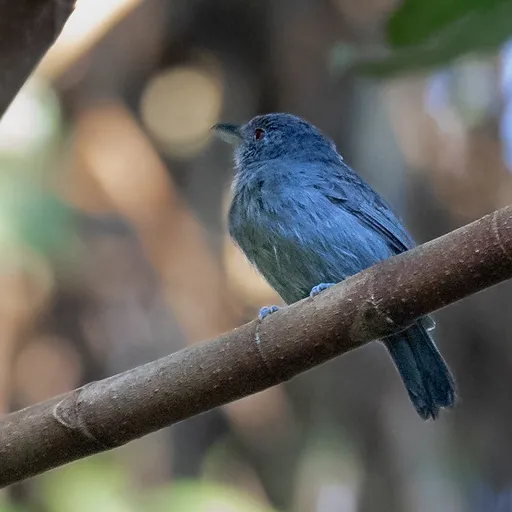
Plain-winged Antshrike
Thamnophilus schistaceus
Least Concern
Listen
XC249591 · Niels Krabbe · Pastaza: Canelos, Ecuador · CC BY-SA 4.0
Overview
The plain-winged antshrike, also known as the black-capped antshrike, is a species of bird in the family Thamnophilidae. It is classified as Least Concern on the IUCN Red List, though its population size is believed to be decreasing.
Identification
- Measures 13 to 14 cm in length and weighs 19 to 21 g, with a stout bill featuring a hook similar to true shrikes.
- Males of the nominate subspecies are almost entirely grey with a brownish tinge on the wings, while females have a rufous crown and yellowish olive-brown upperparts.
- Both sexes possess red irises; males of the T. s. capitalis subspecies display a black crown.
- Song consists of a slightly accelerating series of similar-pitched notes ending in a sharply downslurred note that falls to a lower pitch.
Habitat
Found in Bolivia, Brazil, Colombia, Ecuador, and Peru, this bird inhabits humid evergreen forests, including both seasonally flooded lowlands and drier terra firme uplands. It favours the understorey and midstorey of forest interiors and is typically found at elevations below 1,300 m.
Diet
The diet consists mostly of insects and other arthropods. Foraging is usually conducted singly or in pairs, and the birds regularly join mixed-species feeding flocks. They glean prey from leaves, stems, and branches by hopping, reaching, or briefly hovering, occasionally following army ant swarms.
Did you know?
Although detailed breeding information is scarce, known nests are shallow cups constructed from coarse plant fibers and covered with moss or lichen, suspended in branch forks within 2 m of the ground.
Sources
- Wikipedia · CC BY-SA 4.0
- Wikidata · CC0 1.0