
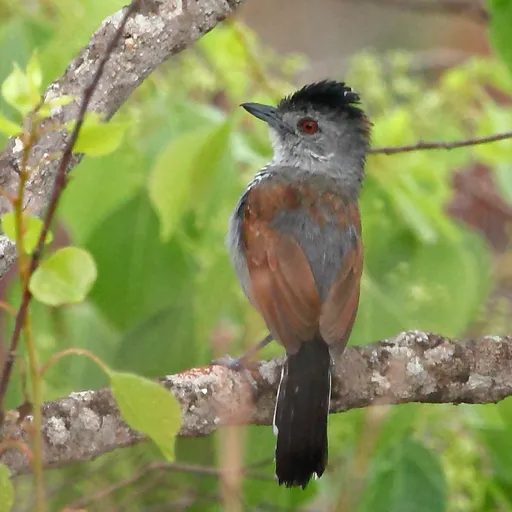
Rufous-winged Antshrike
Thamnophilus torquatus
Least Concern
Overview
The rufous-winged antshrike (Thamnophilus torquatus) is a species of bird in the family Thamnophilidae, commonly known as typical antbirds. It is a monotypic species found in parts of South America and is currently classified as Least Concern on the IUCN Red List.
Identification
- Approximately 14 cm long with a weight of 18 to 20 g, featuring a stout bill with a hook similar to true shrikes.
- Adult males possess a black crown, grey face and upperparts, cinnamon-rufous wings, a black tail with white bars, and a whitish underpart with black breast bars.
- Adult females have a rufous crown, mottled whitish and grey face, pale cinnamon-rufous upperparts, rufous tails, and buffy underparts that may show faint dusky breast bars.
- Song is a moderately long, accelerating series of nasal notes starting with one long, drawn-out note followed by shorter notes and ending in a longer downslurred note.
Habitat
Found in Brazil, eastern Bolivia, and eastern Paraguay, this species inhabits the understorey of cerrado, nearby semi-deciduous woodlands, brushy gallery forest, and second-growth areas such as overgrown pastures. It typically occurs at elevations below 1,000 m but can be found as high as 1,750 m.
Diet
The diet consists mostly of insects and other arthropods. The bird usually forages singly or in pairs within the understorey, hopping through vegetation to glean prey from leaves, stems, and branches, or making short upward sallies from perches. It occasionally drops to the ground to pick prey from leaf litter and sometimes joins mixed-species feeding flocks.
Did you know?
Both sexes participate in building a cup-shaped nest woven from grass, rootlets, and fungal fibres, which is often suspended in a branch fork between 0.7 and 1.5 m above the ground. The incubation period lasts about 15 days, with fledging occurring approximately 10 days after hatching.
Sources
- Wikipedia · CC BY-SA 4.0
- Wikidata · CC0 1.0