
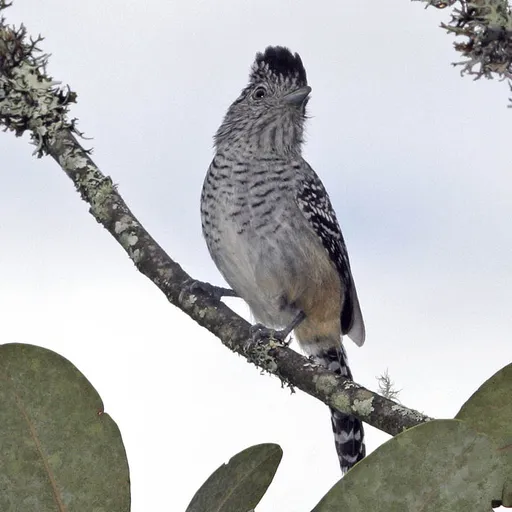
Chapman's Antshrike
Thamnophilus zarumae
Least Concern
Overview
Chapman's antshrike (Thamnophilus zarumae) is a species of bird in the family Thamnophilidae, commonly known as the typical antbirds. It is classified as Least Concern by the IUCN, although its population is believed to be decreasing due to ongoing habitat destruction for agriculture.
Identification
- Measures 14 to 15.5 cm in length and weighs approximately 22 g, featuring a stout bill with a hook similar to true shrikes.
- Adult males of the nominate subspecies display a black crown and crest with black and white streaked forehead and face, contrasting with a medium gray collar and black back barred with white.
- Adult females possess a rufous crest, olive-brown collar, and cinnamon rufous upperparts with buff underparts faintly marked in gray.
- Song consists of an accelerating series of 12-14 nasal notes followed by three higher-pitched, broad-amplitude notes ending in a short rattle or trill.
Habitat
The species inhabits the interior and edges of deciduous and semi-deciduous forests and secondary woodlands in Ecuador and Peru. It favours dense vegetation, including vine-heavy areas, within the forest understorey to mid-storey at elevations ranging from 600 to 2,600 m.
Diet
Its diet includes larval caterpillars, Orthoptera such as grasshoppers, spiders, and berries of Meliaceae trees. It usually forages singly or in pairs, occasionally joining mixed-species feeding flocks, by hopping between branches or climbing to glean prey from leaves, stems, and trunks.
Did you know?
Although currently classified as a distinct species, Chapman's antshrike was originally described as a species, quickly transferred to a subspecies of the barred antshrike, and then later re-recognised as separate after phylogenetic studies showed it was not closely related to the barred antshrike.
Sources
- Wikipedia · CC BY-SA 4.0
- Wikidata · CC0 1.0