
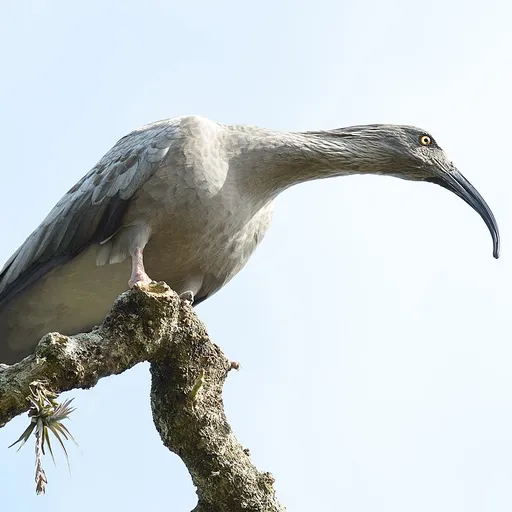
Plumbeous Ibis
Theristicus caerulescens
Least Concern
Overview
The plumbeous ibis is a large, distinctive wading bird endemic to parts of central South America. Classified as Least Concern on the IUCN Red List, it is noted for its robust build and preference for lowland wetlands.
Identification
- Size & Structure: A large bird measuring 71–77 cm in length, characterised by a solid grey colouration and a thick neck.
- Plumage & Crest: Possesses a shaggy grey crest extending down the nape and a prominent white feathered band around the forehead; flight feathers appear dark brown or black with a glossy greenish-bronze sheen.
- Bill & Legs: Features a long, black, downward-curved serrated bill and pinkish-orange legs that darken during the breeding season.
- Vocalisations: Emits loud, diverse calls including a high-pitched, metallic 'pi-pi-pi' that can be heard over long distances, and a slow, energetic trumpeting flight call.
Habitat
Found in central South America, including south-western Brazil, Paraguay, Uruguay, north-eastern Argentina, and Bolivia, with a geographically isolated northern Bolivian population. It primarily inhabits lowland grassy wetlands such as the Pantanal and the Chaco, foraging in marshes, swamps, and lagoons, while roosting in trees near water. The species is also associated with human-modified environments like dams, seasonally flooded rice fields, and highways.
Diet
The diet consists mainly of aquatic invertebrates, particularly snails, mussels, crabs, frogs, fish, and eels, though it also consumes terrestrial vertebrates like snakes and lizards. Foraging involves walking slowly through shallow mud and water, probing rapidly with a bill that is sometimes completely submerged. In the Paraguay-Paraná basin, the species shows a specialisation on molluscs.
Did you know?
Unlike many other ibis species, the plumbeous ibis does not form large intraspecific flocks, typically occurring singly or in pairs, with larger groups rarely exceeding six individuals.
Sources
- Wikipedia · CC BY-SA 4.0
- Wikidata · CC0 1.0