
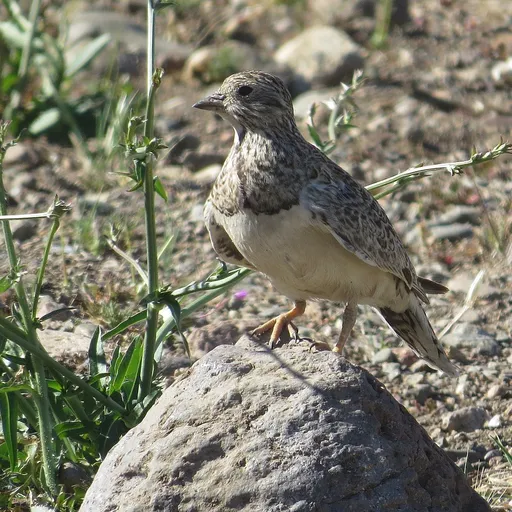
Least Seedsnipe
Thinocorus rumicivorus
Least Concern
Overview
The least seedsnipe (Thinocorus rumicivorus) is a xerophilic bird in the family Thinocoridae and is the smallest member of that family. It is a common species across South America, classified as Least Concern by the IUCN with an estimated range of about 1,300,000 km².
Identification
- Smallest member of the Thinocoridae family with short tails and long pointed wings.
- Ashy, conical beak similar to that of a finch or sand grouse; legs and toes are dull greenish yellow.
- Adult males have a gray face, neck, and breast, with black lines on the throat forming an inverted "T" shape.
- Males perch on prominent bushes or fence posts to deliver nuptial calls sounding like a rapid series of "pu-pu-pu-pu".
Habitat
Natural habitats include temperate grassland, high-altitude grassland, and pastureland, though it can range from sandy beaches to open deserts in northern Chile. The species breeds in Argentina, Bolivia, Chile, and Peru, with records extending to Ecuador, the Falkland Islands, Uruguay, Brazil, and Antarctica.
Diet
Strictly vegetarian in its natural habitat, relying mostly on seeds but also eating leaves and buds. It forages by crouching to snap off plants or stretching to browse tall herbs, deriving most water from succulent plants and rarely drinking. It is known to transfer pollen while feeding on the fleshy growths of Calceolaria uniflora flowers.
Did you know?
The female buries her eggs in the nest scrape with her feet rather than her bill, a behavior that appears to have arisen independently in the Thinocoridae family for predator concealment.
Sources
- Wikipedia · CC BY-SA 4.0
- Wikidata · CC0 1.0