
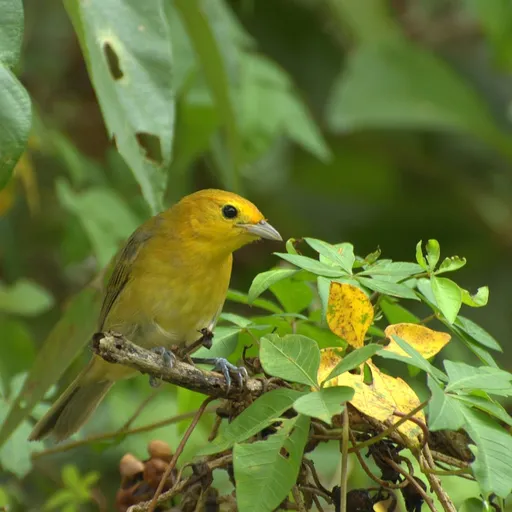
Orange-headed Tanager
Thlypopsis sordida
Least Concern
Overview
The orange-headed tanager (Thlypopsis sordida) is a small bird species in the family Thraupidae, native to South America. It inhabits a variety of habitats including successional vegetation, cerrado, and riparian forest across eight countries. The species is listed as Least Concern by the IUCN due to its large range and stable population.
Identification
- Males feature rufous-orange crowns and head sides, transitioning to bright yellow on the lores and throat, with sandy-gray upperparts.
- Underparts are buff to cinnamon, turning whitish on the centre of the lower breast, belly, and tail.
- The bird is small, measuring approximately 13 cm in length, with a thin, dark bill and gray legs.
- Calls include high-pitched 'tseet' or 'sit' notes, often given rapidly, and geographic song variations ranging from spasmodic 'pits'a' to trilled 'tsi'.
Habitat
Native to South America, the species is found in Argentina, Bolivia, Brazil, Colombia, Ecuador, Paraguay, Peru, and Venezuela. It generally inhabits elevations up to 800 m, though specific regional limits vary, and is the only member of its genus found in the lowlands of the Amazon rainforest. Typical environments include dry to semi-humid cerrado, open woodlands, shrubs, and young secondary growth near rivers.
Diet
This omnivorous species feeds on orthopterans, beetles, flies, spiders, fruit, and seeds. It forages in an active, New World warbler-like manner, gleaning insects from foliage with rapid hops. Less commonly, it hovers or sallies to catch prey in the air.
Did you know?
The genus name Thlypopsis derives from the Ancient Greek word thlupis, which referred to an unknown species of small bird. The species has been recorded as a host to the shiny cowbird, a known brood parasite.
Sources
- Wikipedia · CC BY-SA 4.0
- Wikidata · CC0 1.0