
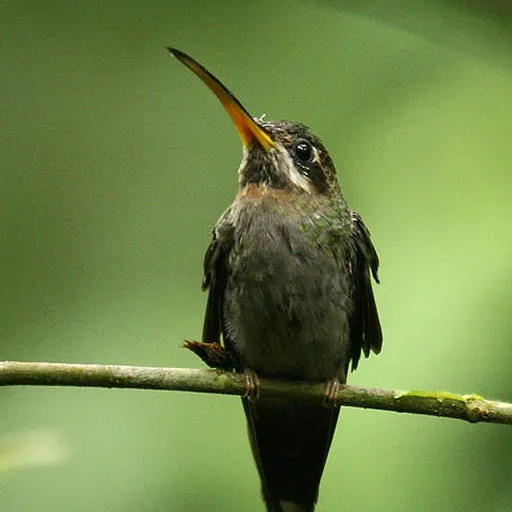
Band-tailed Barbthroat
Threnetes ruckeri
Least Concern
Overview
The band-tailed barbthroat is a medium-sized hermit hummingbird found across Central and South America, ranging from southeastern Guatemala and Belize to western Ecuador and western Venezuela. It is classified as Least Concern by the IUCN and is generally considered common within its range.
Identification
- Adults measure 10 to 11 cm in length, with males weighing 5.5 to 7 g and females 5 to 7 g.
- The nominate subspecies features bronze-green upperparts, an ochraceous throat, and a dark tail with white bases and tips that create a black band near the end.
- Subspecies vary in appearance, with T. r. ventosus displaying a bright orange throat patch and T. r. venezuelensis having a larger ochraceous throat patch than the nominate.
- The bird possesses a nearly straight bill, though it is somewhat more decurved in females, and its song consists of a fast, high-pitched phrase of 5–10 notes, such as 'tzi-tzi-tsee-ee-tsi-tzi-tzi'.
Habitat
The species inhabits the understory and edges of primary forest and old second growth, as well as semi-open shrublands, thickets, and plantations. It is found at elevations ranging from sea level to 1,200 m.
Diet
As a 'trap-line' feeder, the bird visits a circuit of flowering plants to feed on nectar from Heliconia and other tubular flowers, as well as small arthropods, especially spiders. It obtains nectar both by probing flowers and by 'robbing' them through piercing the base of the tube.
Did you know?
The female constructs a cup-shaped nest from plant fibers and cobwebs, attaching it to the underside tip of a long drooping leaf, and is solely responsible for incubating the two white eggs.
Sources
- Wikipedia · CC BY-SA 4.0
- Wikidata · CC0 1.0