
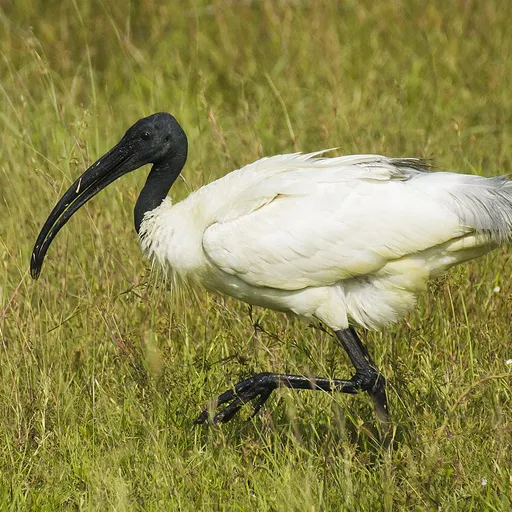
Black-headed Ibis
Threskiornis melanocephalus
Least Concern
Overview
The black-headed ibis (Threskiornis melanocephalus), also known as the Oriental white ibis, is a large wading bird of the ibis family found across South and Southeast Asia. It is classified as Least Concern on the IUCN Red List, although its population has declined considerably in several parts of its range.
Identification
- Overall white plumage contrasting starkly with a conspicuous naked black head and neck.
- Large size, with adults measuring 65–76 cm in length.
- Black, down-curved beak and legs.
- Adults possess light grey ornamental tail feathers that turn jet black during the breeding season, along with blood-red bare patches under the wings.
- Juveniles are distinguishable by greyish feathering on the neck and speckled brown-grey feathering on the wings and back.
- Silent except for ventriloquistic grunts uttered by pairs at the nest, as it lacks a true voice-producing mechanism.
Habitat
Native to South and Southeast Asia ranging from India and Japan, this species is versatile and forages in a wide variety of natural and man-made habitats. These include freshwater and saltwater marshes, lakes, rice fields, ploughed crop fields, irrigation canals, urban lakes, and garbage dumping sites. It nests in heronry colonies near wetlands, building platform nests of sticks lined with grass and threads.
Diet
The species is described as foraging in a range of natural and man-made habitats and spending the maximum proportion of its daily activity budget (48%) feeding, though specific food items are not detailed. It alters its use of preferred foraging habitats by season, preferring natural marshes and fallow fields in summer and spreading out to agricultural fields, grazing lands, and open sewage lines during the monsoon and dry summers respectively.
Did you know?
Like storks and spoonbills, the black-headed ibis lacks a true voice-producing mechanism and is entirely silent except for the ventriloquistic grunts uttered by breeding pairs at the nest.
Sources
- Wikipedia · CC BY-SA 4.0
- Wikidata · CC0 1.0