
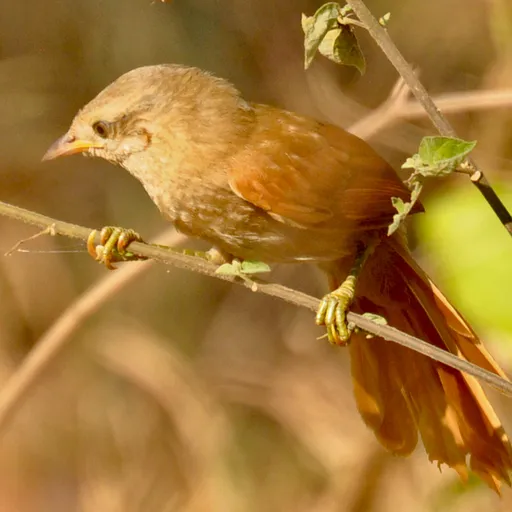
Plain Softtail
Thripophaga fusciceps
Least Concern
Overview
The plain softtail (Thripophaga fusciceps) is a species of bird in the ovenbird family Furnariidae. It is found in Bolivia, Brazil, Ecuador, and Peru, where it is considered a year-round resident of varying forest environments.
Identification
- Size 16 to 18 cm long, weighing 23 to 24 g, with olive-green to yellowish olive legs and feet.
- Plumage varies by subspecies but generally features pale brownish-gray faces with faint pale supercilia in males, rufous tails, and dark rufous wings with brown-tipped flight feathers.
- Song varies by subspecies: the nominate begins with dry ticking notes accelerating to high notes and descending into sputtering ticks, T. f. dimorpha produces a sharp, loud descending churring, and T. f. obidensis has very rhythmic chattering with rattles.
- Females have paler foreheads and underparts than males, while juveniles show faint mottling on the throat and breast.
Habitat
The plain softtail inhabits tropical evergreen and river-edge forest, primarily várzea and the transition zone between it and dryer landscapes, though it can occur in drier deciduous forest. It favours forest edges and dense vine tangles at elevations between 50 and 500 m. Its range is disjunct, covering northern Bolivia, eastern and southeastern Peru, eastern Ecuador, and central Brazil.
Diet
The plain softtail feeds on arthropods, foraging at all levels from the forest understorey to the subcanopy. It typically forages in pairs or small groups, often as part of a mixed-species feeding flock, gleaning prey from dead leaves, debris, and small branches while moving acrobatically along branches and vines.
Did you know?
The plain softtail constructs its nest as a globe of twigs and soft plant material with two entrance tubes low on the side, placed in a branch fork in the canopy, though little else is known about its breeding biology. All three subspecies typically sing in duet.
Sources
- Wikipedia · CC BY-SA 4.0
- Wikidata · CC0 1.0