
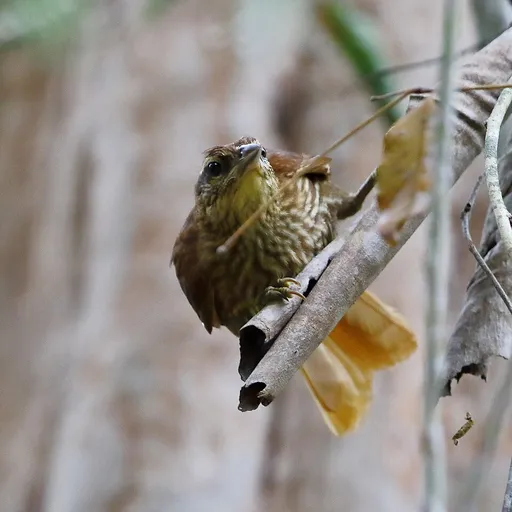
Striated Softtail
Thripophaga macroura
Near Threatened
Overview
The striated softtail, Thripophaga macroura, is a monotypic bird species belonging to the ovenbird family Furnariidae. It is endemic to eastern Brazil and is currently classified as Near Threatened by the IUCN, with population estimates between 1,500 and 7,000 mature individuals.
Identification
- Length of 17 to 18 cm with a dark reddish brown back streaked with black-edged reddish-rufous to rufous-buff.
- A distinctive buff supercilium and pale lores on a buff-streaked brown face, contrasting with orange-rufous to yellowish orange chin and upper throat.
- Dull brown underparts with buff streaks that fade on the belly and undertail coverts.
- Song described as an unstructured mixture of short rattles, 'tjew-tjew-tjew' notes, and sparrowlike chatters, often sung in duet.
Habitat
This species inhabits tropical lowland evergreen forest, particularly areas featuring dense vine tangles, across coastal southeastern Brazil from southern Bahia to northern Rio de Janeiro. It occurs from near sea level up to 1,000 m in elevation and is a year-round resident throughout its range.
Diet
The striated softtail feeds on arthropods, foraging in the understorey to subcanopy levels by gleaning prey mostly in vine tangles but also along branches and in foliage. It is observed foraging singly, in pairs, in small family groups, or as part of mixed-species feeding flocks.
Did you know?
The species builds a nest shaped like a ball of grass, moss, twigs, and rootlets featuring a vertical entrance tube at the bottom, typically placed on a branch fork between 10 and 25 m above the ground.
Sources
- Wikipedia · CC BY-SA 4.0
- Wikidata · CC0 1.0