
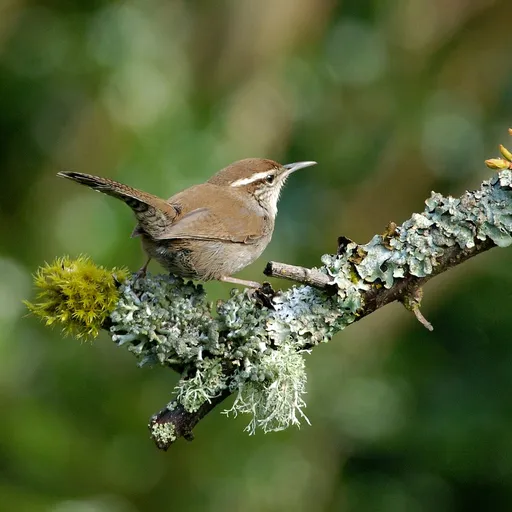
Bewick's Wren
Thryomanes bewickii
Least Concern
Listen
XC870724 · Ana Rebeca Martinez Martinez · Oaxaca de Juárez, Oaxaca, Oaxaca, Mexico · CC0 1.0
Overview
Bewick's wren (Thryomanes bewickii) is a small North American bird that is the sole member of the genus Thryomanes. It is classified as Least Concern by the IUCN, although it has suffered a severe decline and is now extremely rare east of the Mississippi River.
Identification
- Approximately 14 cm in length with grey-brown upperparts, white underparts, and a long white eyebrow.
- Distinguished from similar species by a long tail tipped with white, which is frequently moved to be more obvious to observers.
- Possesses a long, slender, and slightly curved bill.
- Vocalisations include short calls while foraging and a loud, melodious song that can feature up to twenty-two variations from a single male.
Habitat
This species inhabits arid open woodlands, brush-filled areas, thickets, and hedgerows, often near streams. In California, it specifically occupies chaparral shrublands. Its historic range spanned much of the United States and Mexico, but it now persists primarily along the Pacific Coast, in Mexico, and in the southwestern United States.
Diet
Bewick's wrens are insectivores that glean insects, insect eggs, and spiders from vegetation and the ground, sometimes hanging upside down to access prey. They kill insects before swallowing them whole and may supplement their diet with seeds in winter or visit backyard feeders for suet and sunflower seeds.
Did you know?
Males learn their songs from neighboring males rather than their fathers, meaning their song patterns differ from their parents, and they may even use ventriloquism to further vary their vocalisations.
Sources
- Wikipedia · CC BY-SA 4.0
- Wikidata · CC0 1.0