
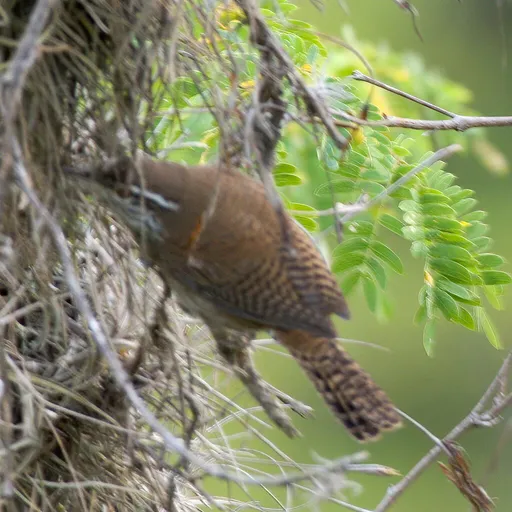
Niceforo's Wren
Thryophilus nicefori
Critically Endangered
Listen
XC634790 · Nelson Hernández · Bucaramanga, Bucaramanga, Santander, Colombia · CC BY 4.0
Overview
Niceforo's wren (Thryophilus nicefori) is a Critically Endangered wren species endemic to Colombia. It was first described in 1946 and is currently known from a highly fragmented global population of approximately 30–200 mature individuals.
Identification
- Thryophilus nicefori is a medium-sized wren averaging 14.5–15 cm in length.
- Adult plumage features a dull olive-grey head and mantle that becomes slightly rufescent on the back, with white underparts that turn greyish on the flanks.
- The face has black and white streaks with a long white supercilium bordered by fine black lines.
- Wings are finely barred, and the undertail coverts show broad black barring.
Habitat
Found in subtropical or tropical high-altitude dry shrubland between 1,132 and 1,840 m, this species prefers areas with dense understory and abundant leaf litter. Its range is restricted to the Chicamocha River valley and nearby river basins in Boyacá and Santander, Colombia, as well as the Serranía de los Yariguíes.
Diet
The species is largely terrestrial, foraging primarily within 2.66 m of the ground. It feeds mainly on arthropods by gleaning in leaf litter, pecking on branches, and searching in tree holes.
Did you know?
Niceforo's wrens construct their nests near wasp colonies, a strategy that deters predators and increases offspring survival.
Sources
- Wikipedia · CC BY-SA 4.0
- Wikidata · CC0 1.0