
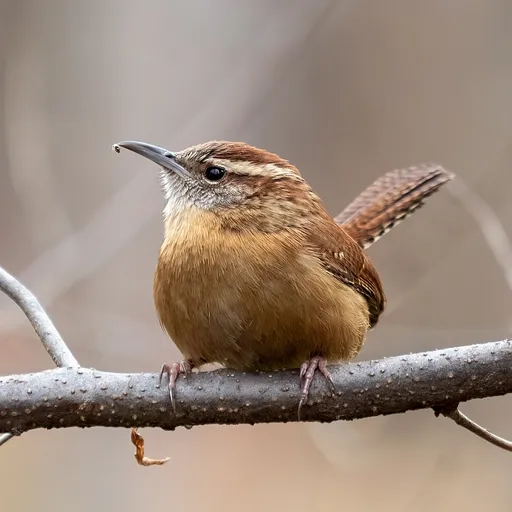
Carolina Wren
Thryothorus ludovicianus
Least Concern
Listen
XC819783 · Anonymous · Highland Falls, Orange County, New York, United States · CC0 1.0
Overview
The Carolina wren (Thryothorus ludovicianus) is a common species of wren found across the eastern United States, southern Ontario, and parts of Mexico and Central America. It is the state bird of South Carolina and is generally inconspicuous, preferring to stay within dense cover rather than remaining in open spaces for extended periods.
Identification
- Length between 12.5 and 14 cm, making it the second-largest wren in the United States after the cactus wren.
- Rich brown crown appearing chestnut on the rump, with a distinctive white supercilium bordered by black.
- Grey underparts that transition to a warmer buff colour on the chest and flanks.
- Loud, energetic song transcribed as 'teakettle' or 'cheery', often sung with the tail pointed downward.
Habitat
These birds inhabit dense cover in forests, farm edges, and suburban areas, favouring riparian forests, swamps, overgrown farmland, and thick shrubs. They also show an affinity for dilapidated buildings and unkempt yards in man-made environments. Their range is restricted in the north by severe winters, though mild conditions can lead to temporary northward extensions.
Diet
Carolina wrens forage primarily on or near the ground, in tangled vegetation, or by probing bark crevices and picking up leaf litter. Their diet consists mainly of invertebrates such as beetles, spiders, and ants, supplemented by small lizards and tree frogs.
Did you know?
Female Carolina wrens possess song control regions that would appear to make them capable of singing with repertoires similar to those of males, though only males actively sing to advertise territory. The bird was originally placed in the genus Troglodytes by Louis Pierre Vieillot before being moved to its own genus, Thryothorus, meaning 'reed jumper'.
Sources
- Wikipedia · CC BY-SA 4.0
- Wikidata · CC0 1.0