
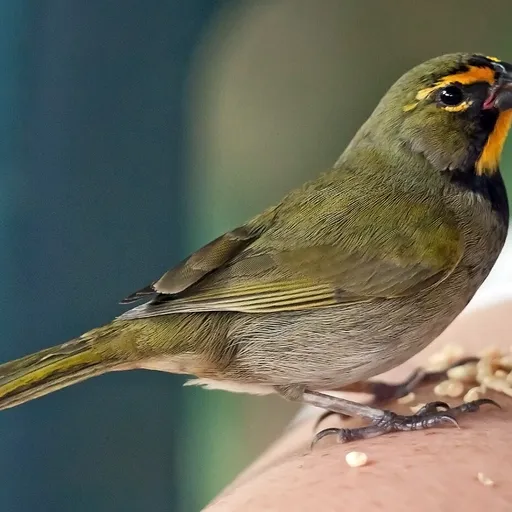
Yellow-faced Grassquit
Tiaris olivaceus
Least Concern
Listen
XC915753 · JUAN ANTONIO ALONSO DE JUAN · Vereda La Máquina, Pacho, Cundinamarca, Colombia · CC BY 4.0
Overview
The yellow-faced grassquit (Tiaris olivaceus) is a small passerine bird in the tanager family Thraupidae and the only member of the genus Tiaris. Native to Central America, South America, and the Caribbean, it is classified as a species of Least Concern by the IUCN. It is non-migratory but may move locally outside the breeding season.
Identification
- Adult males feature an olive-green back, black face and breast, and bright yellow throat, supercilia, and lower eyelid spots, with greyish-olive underparts.
- Females are duller, appearing olive-green above and pale grey below, with much weaker and often barely visible yellow facial patterns.
- Small in size at 10–10.7 cm, with a conical bill that is sharper than that of related seedeaters and grey legs.
- The call is a weak buzzing trilled ttttt-tee, while the song consists of high, thin, rapid trills that are melodious but subdued.
Habitat
This species breeds from central Mexico to northern Ecuador and north-western Venezuela, as well as on the Greater Antilles and nearby islands. It inhabits lowlands and foothills up to 2,300 m in semi-open areas such as roadsides, pastures, weedy fields, and low scrub. It has also been introduced to Hawaii and occasionally appears as a vagrant in southern Texas and Florida.
Diet
The yellow-faced grassquit feeds mainly on grass seeds, as well as other seeds, berries, and insects. It typically plucks food directly from inflorescences or gathers it from the ground. Insect prey is hunted among foliage in a manner similar to New World warblers.
Did you know?
During courtship, the male vibrates his wings while singing and sits just 1–2 inches away from the female to ensure she can hear his subdued song. The species tends to benefit from deforestation, as it expands its range into areas where human activity has altered the landscape.
Sources
- Wikipedia · CC BY-SA 4.0
- Wikidata · CC0 1.0