
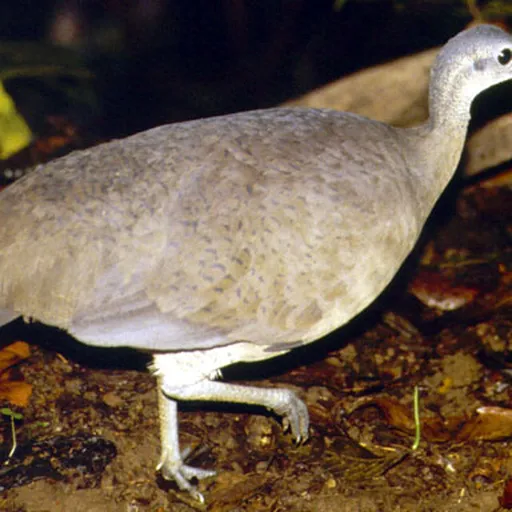
Great Tinamou
Tinamus major
Least Concern
Listen
XC251636 · Niels Krabbe · Zamora-Chinchipe: 'Cabañas Yankuam' 2 km S Las Orchideas, Nangaritza Valley, Ecuador · CC BY-SA 4.0
Overview
The great tinamou (Tinamus major) is a large ground-dwelling bird native to Central and South America, belonging to the family Tinamidae. Recognised as the closest living relatives of the ratites, these birds are capable of flight but are generally weak fliers. The species is classified as Least Concern on the IUCN Red List due to its wide distribution across 6,600,000 km².
Identification
- Body length ranges from 38 to 46 cm, with females averaging 1,097 g and males 960 g.
- Plumage is light to dark olive-green with a whitish throat and belly, black-barred flanks, and cinnamon undertail coverts.
- Distinctive markings include a rufous crown and neck, a blackish occipital crest and supercilium, and blue-grey legs.
- Emits a distinctive call of three short, tremulous but powerful piping notes, typically heard in the early evening.
Habitat
Inhabits subtropical and tropical forests, including rainforest, lowland evergreen forest, river-edge forest, swamp forest, and cloud forest at altitudes between 300 and 1,500 m. Unlike some other tinamous, the great tinamou is relatively resilient to forest fragmentation. Its range extends from southeast Mexico and Guatemala across Central America to South America, reaching as far south as Bolivia and west Brazil.
Diet
Forages in the leaf litter of the dark understory, seeking seeds, fruit, and small animals such as insects, spiders, frogs, and small lizards. The species shows a particular fondness for plants in the families Lauraceae, Annonaceae, Myrtaceae, and Sapotaceae.
Did you know?
The great tinamou possesses the highest percentage of skeletal muscle devoted to locomotion among all birds, accounting for 56.9% of its total body weight. This extensive muscular development for movement occurs simultaneously with having the smallest heart relative to body weight of any bird species.
Sources
- Wikipedia · CC BY-SA 4.0
- Wikidata · CC0 1.0