
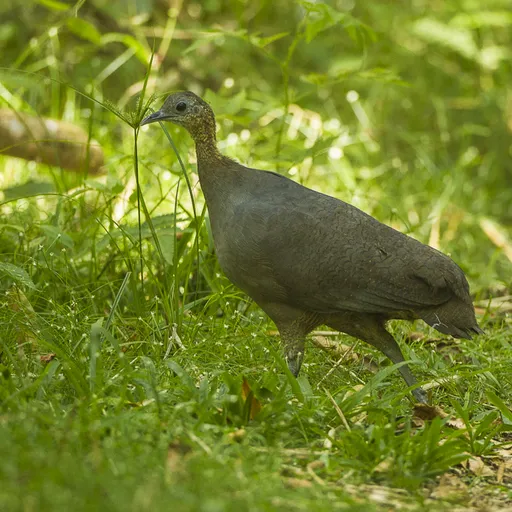
Solitary Tinamou
Tinamus solitarius
Near Threatened
Overview
The solitary tinamou (Tinamus solitarius) is a large ground-dwelling bird native to the Atlantic forest of eastern Brazil. As a member of the tinamou family, it belongs to the ratite group of birds, though unlike other ratites, it retains the ability to fly, albeit weakly.
Identification
- A large brownish bird averaging 45 cm in length, heavily barred with black.
- Grey neck, breast, and flanks contrast with a white belly and a yellowish head and neck.
- Features a dark brown crown, a white throat, and a distinctive buff line on the side of the neck.
Habitat
This species inhabits lowland humid tropical forests and montane forests up to 1,200 m elevation across southeastern Bahia, eastern Minas Gerais, Espírito Santo, Rio de Janeiro, São Paulo, eastern Mato Grosso do Sul, Paraná, Santa Catarina, and northern Rio Grande do Sul in Brazil. Its range extends to southeastern Paraguay and the extreme north-east of Argentina in Misiones province. It readily uses secondary forests and can tolerate selective logging, though it avoids large plantations of exotic species.
Diet
The solitary tinamou feeds on fruits and seeds gathered from the ground or low plants. It forages on the forest floor, utilizing dense understorey vegetation such as caeté, bamboo, and heart-of-palm trees.
Did you know?
The species demonstrates a high capacity for colonisation, having persisted in numbers within a 1,500-acre forest fragment where they were not originally found. This adaptability is notable given the threats posed by deforestation and hunting that have led to their Near Threatened status.
Sources
- Wikipedia · CC BY-SA 4.0
- Wikidata · CC0 1.0