
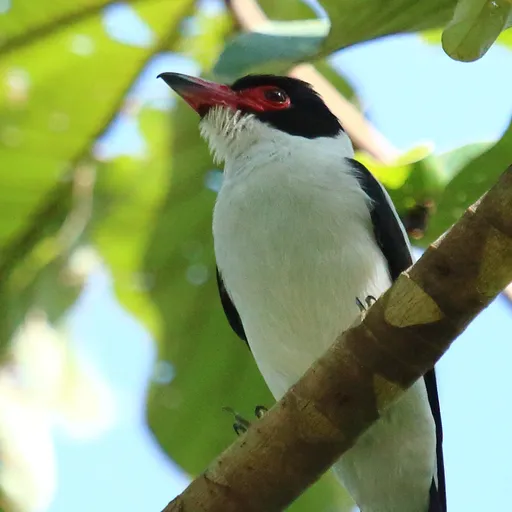
Black-tailed Tityra
Tityra cayana
Least Concern
Listen
XC249016 · Niels Krabbe · Orellana: 'Maxus' road km 37 (27 km SSE Pompeya), Ecuador · CC BY-SA 4.0
Overview
The black-tailed tityra (Tityra cayana) is a medium-sized passerine bird found in tropical South America. It is classified in the family Tityridae and is considered a species of Least Concern by the IUCN Red List.
Identification
- A robust, short-tailed bird measuring 20–22 cm in length with a long, hook-tipped bill.
- Males are dull white above and below with black rectrices, primaries, and secondaries, plus a black cap extending below the eyes.
- Females feature dark brown wings and tail, with brown patterns on the head, back, and underside.
- Both sexes possess rosy-red bare skin around the eye extending to the red-based, black-tipped bill.
- Characterised by a buzzing short call rendered as 'ed', 'rek', 'urd' or 'wenk', often called in flight.
Habitat
This year-round resident inhabits forest edges, second growth, and plantation shade trees in the Pantanal and cerrado, as well as terra firme and várzea. It is usually found below 500 metres elevation but can occasionally reach 1,100 metres above sea level.
Diet
Adults are predominantly frugivores, gleaning medium-sized fruits from vegetation or picking them in mid-hover. While they catch some large insects, these are mainly fed to young birds, with adults rarely attending mixed-species feeding flocks. They serve as locally important dispersers for species such as the Meliaceae Cabralea canjerana.
Did you know?
The species possesses a peculiar vestigial ninth primary feather. Its nest, located in a tree hole several metres above the ground, is incubated solely by the female for almost three weeks, while both parents feed the chicks.
Sources
- Wikipedia · CC BY-SA 4.0
- Wikidata · CC0 1.0