
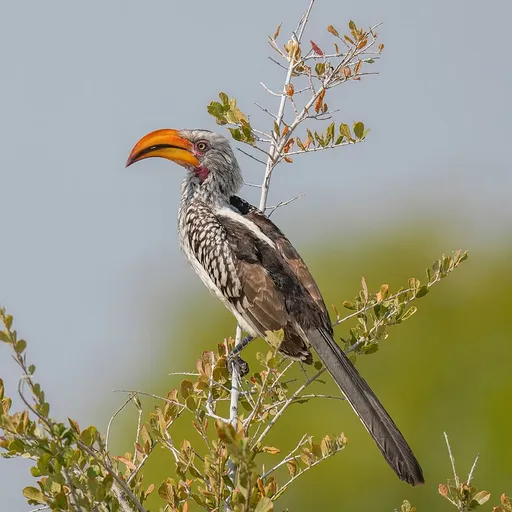
Southern Yellow-billed Hornbill
Tockus leucomelas
Least Concern
Overview
The southern yellow-billed hornbill, Tockus leucomelas, is a medium-sized hornbill species found in southern Africa. It is a common and widespread resident of dry thornveldt and broad-leafed woodlands.
Identification
- Medium-sized bird measuring 48–60 cm in length, with a huge, long, down-curved yellow beak that can account for up to one-sixth of its total body length.
- Plumage features a black back with abundant white spots and stripes, a white belly, a grey neck, and a lightly striated chest.
- Possesses stubby legs and toes, with the front three toes fused near the base, and yellow eyes surrounded by pinkish skin.
- Vocalisations include a piercing cry, as well as whistling, grunting, and caqueting sounds.
Habitat
This species is near endemic to the dry savannas of southern Africa, ranging from Angola and Namibia in the west to Mozambique and KwaZulu-Natal in the east. It primarily inhabits dry, open savannas and woodlands, showing a preference for acacia and broadleaved woodlands, with the highest concentrations often found in open mopane scrub.
Diet
The bird feeds mainly on the ground, consuming arthropods such as termites, beetles, larvae, grasshoppers, and caterpillars, alongside centipedes, scorpions, small mammals, and plant matter like berries, fruits, nuts, and eggs. It uses its beak as forceps to grasp food, aided by serrated inner cutting edges that facilitate crushing and fragmentation.
Did you know?
During nesting, the female seals herself inside the cavity using a wall made from her own droppings and food remains, leaving only a vertical slit through which the male feeds her until the chicks are hatched.
Sources
- Wikipedia · CC BY-SA 4.0
- Wikidata · CC0 1.0