
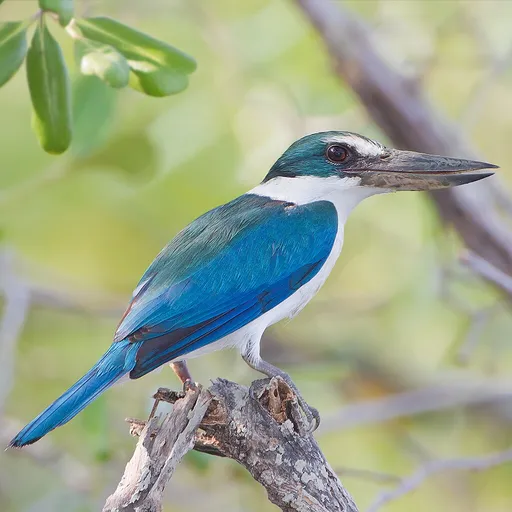
Collared Kingfisher
Todiramphus chloris
Least Concern
Overview
The collared kingfisher (Todiramphus chloris), also known as the mangrove kingfisher, is a medium-sized tree kingfisher with a wide distribution extending from the Red Sea across southern Asia to Melanesia. It is classified as Least Concern on the IUCN Red List due to its vast range and common to abundant population.
Identification
- Length of 23 to 25 cm with plumage varying from blue to green above and white or buff underparts, distinguished by a white collar around the neck.
- Large black bill with a pale yellow base to the lower mandible, sometimes accompanied by a white stripe or spot over the eye and a black stripe through the eye.
- Females tend to be greener than males, while immature birds appear duller with dark scaly markings on the neck and breast.
- Produces a loud, harsh, and metallic "kee-kee-kee" call that varies geographically.
Habitat
Most commonly found in coastal areas, particularly mangrove swamps, but also inhabits farmland, open woodland, grassland, and gardens. On islands, the species may range further inland into forest or mountain areas, with its range stretching from north-east Africa and Arabia to Southeast Asia and Melanesia.
Diet
Feeds on small crabs and shrimps in coastal regions, but also consumes insects, spiders, earthworms, snails, frogs, lizards, small snakes, small fish, and occasionally small birds and mice. It perches motionless to spot prey, glides down to catch it, and returns to the perch to pound larger items against a branch before swallowing.
Did you know?
The bird's scientific name, chloris, is modern Latin for 'green' or 'greenish', referencing its common plumage colouration.
Sources
- Wikipedia · CC BY-SA 4.0
- Wikidata · CC0 1.0