
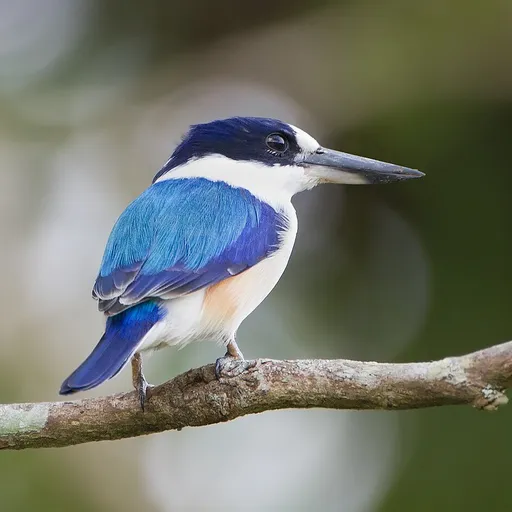
Forest Kingfisher
Todiramphus macleayii
Least Concern
Overview
The forest kingfisher (Todiramphus macleayii), also known as Macleay's or the blue kingfisher, is a predominantly blue and white species of tree kingfisher. It is a resident of subtropical and tropical regions, listed as a species of least concern on the IUCN Red List.
Identification
- Plumage: Blue wings, head, and tail contrasting with a white breast, abdomen, and nape, though females have a blue nape rather than white.
- Markings: A distinct black band stretches from the bill through the eyes to the ear coverts, accompanied by a white patch in front of the eyes; a white patch is visible on the wings in flight.
- Size and Structure: Measures 21.5–25.5 cm in length with dark brown irises and dark grey legs and feet; immature birds appear duller with a blackish crown.
- Song: Emits a shrill 't-reek' call, repeated regularly, most often heard in the early morning.
Habitat
Native to Indonesia, Papua New Guinea, the Solomon Islands, and Australia, the species inhabits subtropical or tropical dry and moist lowland forests, as well as mangrove forests and Melaleuca swampland. In Australia, it occurs on or near the coastline from Port Stephens north to Cape York and west across the Top End, acting as a summer visitor in the southern parts of its range.
Diet
This kingfisher hunts invertebrates such as bugs, beetles, grasshoppers, spiders, and worms, as well as small fish, frogs, lizards, and snakes. It forages by sally-pouncing from a high perch, diving to the ground or water to seize prey, and often kills the catch by hitting it against a branch.
Did you know?
The nest is constructed as a short burrow into a round chamber within an arboreal termite nest, situated 4–12 m above the ground.
Sources
- Wikipedia · CC BY-SA 4.0
- Wikidata · CC0 1.0