
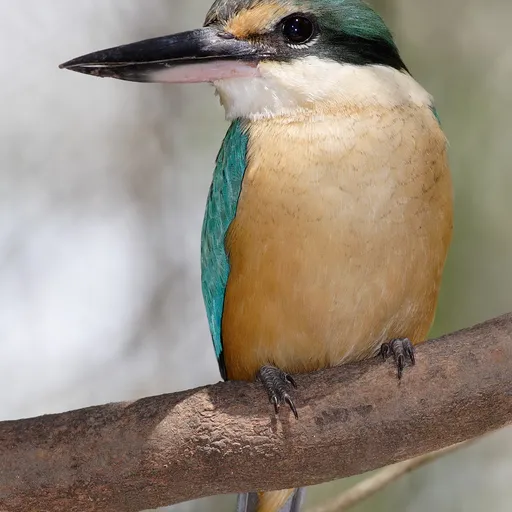
Sacred Kingfisher
Todiramphus sanctus
Least Concern
Overview
The Todiramphus sanctus is a medium-sized woodland kingfisher that inhabits mangroves, woodlands, forests, and river valleys across Australia, New Zealand, and parts of the western Pacific. It is classified as least concern on the IUCN Red List with an increasing population trend.
Identification
- Mostly blue-green to turquoise above with white underparts and collar feathers
- Features a black mask and buff lores
- Females are usually greener, duller, and less buff beneath than males
- Adults measure 20–23 cm in length
Habitat
It is distributed across Australia, New Zealand, New Guinea, and the western Pacific, including islands such as Lord Howe, Norfolk, New Caledonia, and the Kermadec Islands. In Australia, it inhabits open eucalypt forests, melaleuca swamps, mangroves, wetlands, river margins, farmland, parks, and gardens. Populations in the southern two-thirds of Australia migrate northwards to New Guinea, the eastern Solomon Islands, and Indonesia after the breeding season.
Diet
It feeds on a wide variety of invertebrates, particularly insects and spiders, as well as small crustaceans, frogs, small rodents, reptiles, and occasionally fish or small birds. The bird typically sits on a low branch and waits for prey to pass by. It then swoops down to grab prey by briefly landing or hovering before returning to its perch to beat and swallow the catch.
Did you know?
The species name 'sacred' originates from Polynesian natives who held the bird in superstitious veneration because it frequently inhabited marae and burial grounds, and was believed to have the power of control over the waves.
Sources
- Wikipedia · CC BY-SA 4.0
- Wikidata · CC0 1.0