
Common Tody-Flycatcher
Todirostrum cinereum
Least Concern
Listen
XC248246 · Niels Krabbe · Esmeraldas: Atacames Beach, Ecuador · CC BY-SA 4.0
Overview
The common tody-flycatcher (Todirostrum cinereum) is a tiny passerine bird belonging to the tyrant flycatcher family. It is a year-round resident found across a vast range from Mexico to northern Argentina and southern Brazil, though it avoids the Amazon Basin and Chile.
Identification
- A tiny, big-headed bird measuring 8.8 to 10.2 cm in length and weighing between 4 and 8 g.
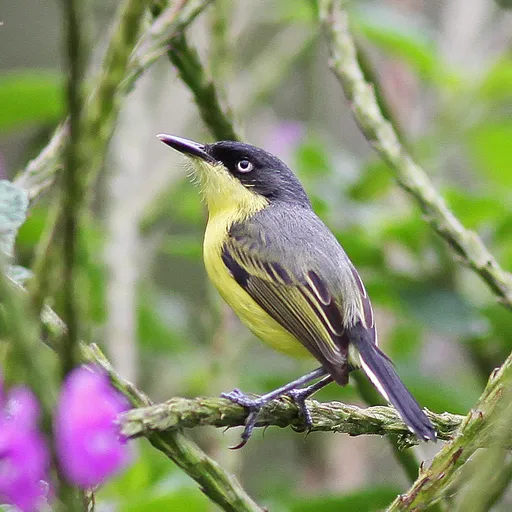
- Adult males feature a glossy black forecrown with a slate-gray hindcrown, while females have a grayer head and an entirely pinkish-white mandible.
- Possesses a long, flattened, straight bill that is all-black in males but has a pinkish-white base in both sexes.
- Entire underparts are bright yellow, contrasting with black wings that display yellow-edged flight feathers and two distinct wing bars.
- Vocalisations include low, short, dry 'trrr-trrr' trills and high 'tic' notes that can be repeated up to 110 times per minute during the nesting season.
Habitat
This species inhabits a wide variety of open and semi-open landscapes, including secondary forests, forest edges, mangroves, riverine belts, open woodlands, plantations, and gardens, while shunning dense forest. It ranges in elevation from sea level up to 2,200 m in Colombia and 2,000 m in Brazil.
Diet
The common tody-flycatcher feeds on a wide variety of arthropods and also consumes fruit. It primarily forages in dense vegetation near the ground by gleaning from foliage while perched or using short upward and outward sallies, though it occasionally ascends to the canopy or captures prey in mid-air.
Did you know?
Although it shuns dense forests, the bird survives well in converted and secondary habitats, actually benefiting from deforestation by spreading into clearings and plantations where it is usually common.
Sources
- Wikipedia · CC BY-SA 4.0
- Wikidata · CC0 1.0