
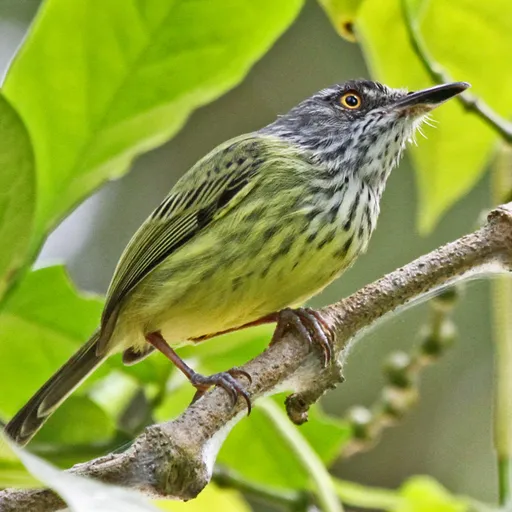
Spotted Tody-Flycatcher
Todirostrum maculatum
Least Concern
Listen
XC248766 · Niels Krabbe · Orellana: river island at Añangu, Ecuador · CC BY-SA 4.0
Overview
The spotted tody-flycatcher (Todirostrum maculatum) is a small bird in the family Tyrannidae, known as a tyrant flycatcher. It is classified as a species of Least Concern by the IUCN, with a stable population across a large range in South America and Trinidad.
Identification
- Measures 8.9 to 10.2 cm in length and weighs 6.4 to 8.3 g.
- Mostly grey head with a small white spot above the lores and black and white streaks on the crown; olive back and rump.
- Throat and upper breast are white with narrow black streaks, while the belly is mostly yellow with dark olive streaks on the sides.
- Bill is black with some white on the mandible; legs and feet are pinkish grey; iris is usually yellowish orange.
- Song consists of an extremely high, slow, staccato series of evenly spaced, slightly descending notes, often each note doubled in duet.
Habitat
Found on Trinidad and in mainland South American countries excluding Argentina, Chile, Paraguay, and Uruguay. Primarily inhabits wet landscapes such as mangroves, dense thickets along oxbow lakes, and major rivers, though it also occurs in open shrubby areas like clearings and household gardens. Elevation ranges up to 500 m, though lower in specific regions like Venezuela and Ecuador.
Diet
Feeds on arthropods, typically foraging in pairs near the ground in dense vegetation. It primarily takes prey from foliage, vines, and branches using short upward sallies from a perch. Prey capture is accompanied by an audible bill snap.
Did you know?
The nest is a longish pouch with a side entrance made of grasses and plant fibres held together with spider web, typically hanging from a branch near a wasp nest. Both sexes participate in building the nest, but the female alone is responsible for incubating the one or two red-dotted white eggs.
Sources
- Wikipedia · CC BY-SA 4.0
- Wikidata · CC0 1.0