
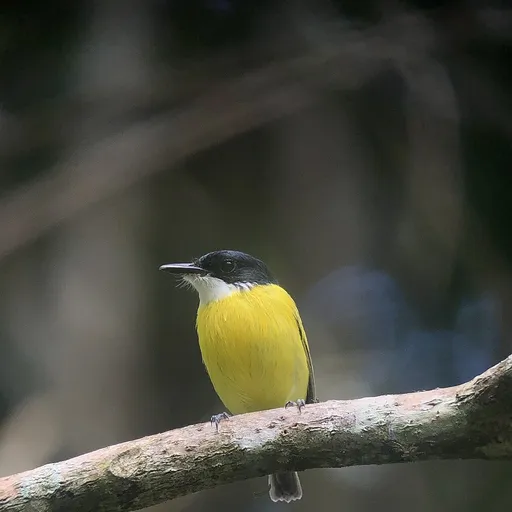
Black-headed Tody-Flycatcher
Todirostrum nigriceps
Least Concern
Overview
The black-headed tody-flycatcher (Todirostrum nigriceps) is a small, non-migratory bird in the tyrant flycatcher family found in southern Central and north-western South America. It is an insectivorous species that resides in the canopy of subtropical and tropical moist lowland forests.
Identification
- Glossy black head, throat, and wings contrasted with bright yellow underparts and olive-yellow upperparts.
- Short, black tail and a relatively large head with a straight, black bill.
- Bluish-gray legs and dark irises with no eye-rings; males and females share the same plumage.
- Song consists of 5 to 8 high-pitched "jyip" notes that accelerate and rise in pitch, often sounding insect-like.
Habitat
This species inhabits the canopy and edges of humid, subtropical or tropical moist lowland forests, often selecting the tallest trees. Its range includes eastern Costa Rica, Panama, north and western Colombia, far west Venezuela, and western Ecuador, bordering mountain ranges without extending into the Andes. It is also occasionally found in second-growth forests impacted by human disturbance.
Diet
Primarily insectivorous, it forages alone or in pairs within dense foliage and along canopy edges, targeting flowering trees to catch attracted insects such as beetles, flies, spiders, and ants. The species has evolved a diet of non-overlapping arthropod species to minimise competition with other tody-flycatchers.
Did you know?
Tody-flycatchers have evolved non-overlapping diets of specific arthropod species to ensure access to food and avoid competition with similar species. Additionally, they often build their nests near wasp nests to secure a nearby food source, though these nests are occasionally usurped by piratic flycatchers.
Sources
- Wikipedia · CC BY-SA 4.0
- Wikidata · CC0 1.0