
Painted Tody-Flycatcher
Todirostrum pictum
Least Concern
Overview
The painted tody-flycatcher (Todirostrum pictum) is a small bird in the family Tyrannidae, native to the northern parts of South America. It inhabits forested landscapes across Brazil, French Guiana, Guyana, Suriname, and Venezuela, with a hypothetical presence in Colombia.
Identification
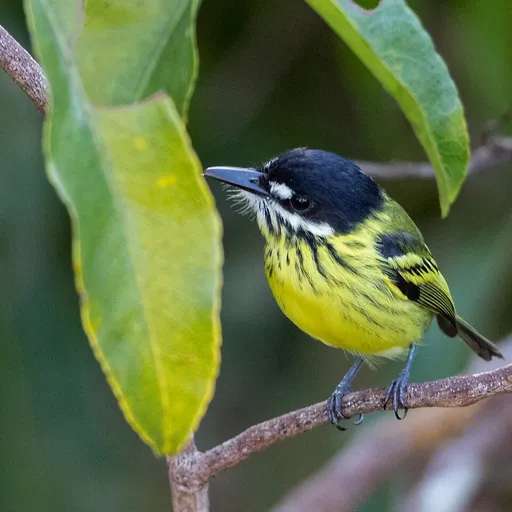
- A compact bird 9 to 10.2 cm long, featuring a mostly black head with a distinctive white spot above the lores and a long white 'moustache'.
- The nape is separated from the olive back by a narrow yellow band, while the wings are black with yellow edges creating two wing bars.
- Underparts are bright yellow with black streaks on the breast and sides; the bill and legs are black.
- Vocalisations are piercing and surprisingly loud, including a song of 8–12 bright, emphatic 'peek!' notes and a call described as a double-sounding 'chevik'.
Habitat
Found in a variety of forested landscapes including humid terra firme, várzea, dry forest, and mature secondary forest, typically occupying the canopy and its edges. It also occurs in clearings and plantations provided tall trees are present, ranging in elevation from sea level to 400 m.
Diet
This species feeds on arthropods, usually foraging singly or in pairs within the forest canopy and along its edges. It primarily captures prey from foliage by making short upward and outward sallies from a perch.
Did you know?
Despite its small size of only 6 to 8 g, the bird produces piercing and surprisingly loud vocalisations. It is often overlooked visually in the field and is most frequently located by its voice.
Sources
- Wikipedia · CC BY-SA 4.0
- Wikidata · CC0 1.0