
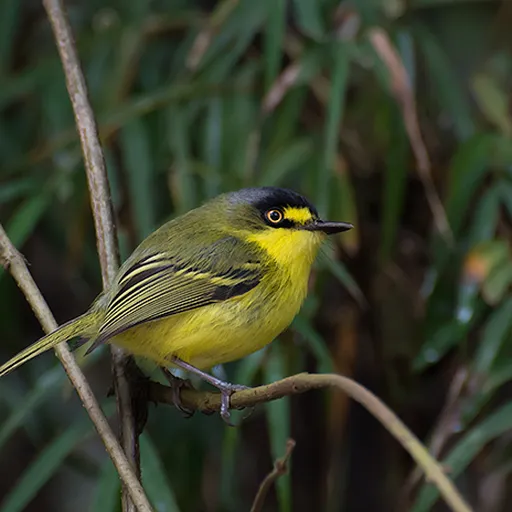
Yellow-lored Tody-Flycatcher
Todirostrum poliocephalum
Least Concern
Overview
The yellow-lored tody-flycatcher, also known as the grey-headed tody-flycatcher, is a small bird species in the tyrant flycatcher family that is endemic to Brazil. It is classified as Least Concern by the IUCN, although its population is believed to be decreasing despite the absence of immediate threats.
Identification
- Measures 8.8 to 10.2 cm in length and weighs approximately 5 to 6 g.
- Features a slate-grey crown and nape with large lemon or sulphur yellow patches on the lores and greenish cheeks.
- Underparts are entirely lemon or sulphur yellow, contrasting with olive back and rump.
- Song consists of a high, weak 'twit' followed by an energetic 'witwit---', sometimes described as 'spit-spit-spit-spit' or 'cheep, chip-chip'.
Habitat
Found in southeastern Brazil ranging from southeastern Bahia to far northeastern Rio Grande do Sul, and inland into Minas Gerais and northern Paraná. The species inhabits various forest types, typically dense vegetation along forest edges, as well as light woodland, gardens, and urban parks. It ranges in elevation from sea level to 1,200 m.
Diet
Feeds on insects, typically foraging in pairs or small family groups, though occasionally singly or in mixed-species flocks. It primarily takes prey from foliage using short upward sallies from a perch, usually near the ground but sometimes higher up.
Did you know?
The female builds a compact oval closed bag nest with a side entrance using dry leaves, bark strips, and plant materials bound with spider web. These nests often hang up to 4 m above the ground and are frequently suspended over water.
Sources
- Wikipedia · CC BY-SA 4.0
- Wikidata · CC0 1.0