
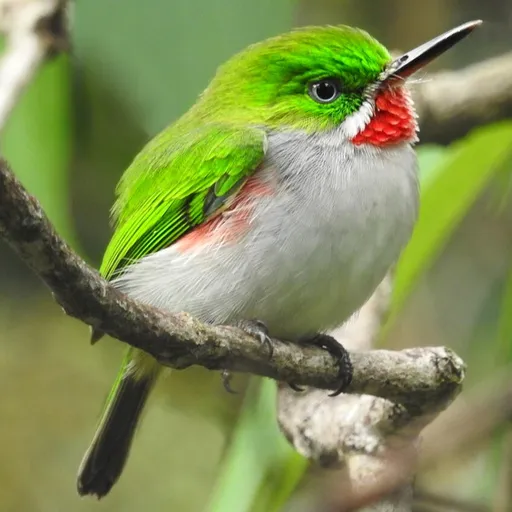
Narrow-billed Tody
Todus angustirostris
Least Concern
Overview
The narrow-billed tody (Todus angustirostris) is a small bird endemic to the Caribbean island of Hispaniola, where it coexists with the broad-billed tody. It is one of only two tody species found on this island and is currently classified as Least Concern by the IUCN, though its population is believed to be decreasing.
Identification
- Very small and chunky with a short tail, weighing approximately 7.5 g.
- Bright green upperparts transitioning to emerald near the white eyes, contrasting with a carmine red chin and throat separated by a white malar stripe.
- Deep lead gray on the sides of the neck and breast, with white breasts and geranium pink to red flanks; the underwing is sulphur yellow.
- A two-note call described as 'chip-chee' accented on the second syllable, accompanied by a short chatter.
Habitat
Resident throughout Hispaniola, occurring in both the Dominican Republic and Haiti, the species primarily inhabits dense wet jungle and forest at elevations between 900 and 2,400 m. It is also found locally at lower elevations where its range overlaps with that of the broad-billed tody.
Diet
The diet consists almost entirely of insects, with at least 49 families identified, though the species does not prey on larger butterflies or caterpillars. It tends to forage high in the forest canopy, particularly within mixed-species flocks, but also feeds low among coffee bushes in plantations.
Did you know?
Both sexes excavate nest burrows about 30 cm deep in earthen banks, and the species is noted for making display flights that include wing rattling, a behaviour not seen in other members of its order.
Sources
- Wikipedia · CC BY-SA 4.0
- Wikidata · CC0 1.0