
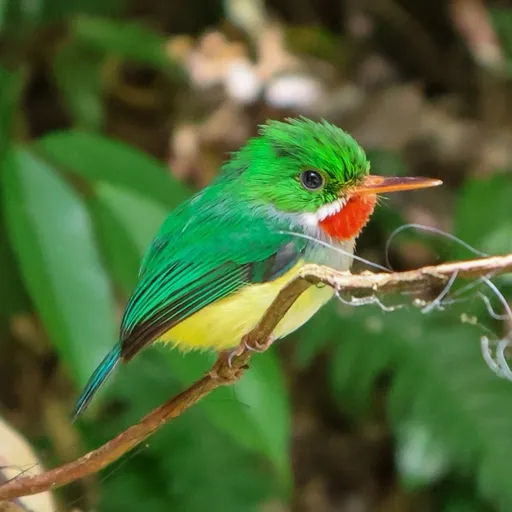
Puerto Rican Tody
Todus mexicanus
Least Concern
Overview
The Puerto Rican Tody (Todus mexicanus), locally known as San Pedrito, is a small, brightly colored, non-passerine bird endemic to the main island of Puerto Rico. Recognised in 2022 as the official national bird of Puerto Rico, it belongs to the Todus genus, which comprises the closest relatives to Central American motmots.
Identification
- Average body length of 11 cm and weight of 5 to 6 g, making it one of the smallest representatives of the order Coraciiformes.
- Emerald green upperparts, a white belly and chest, light-yellow flanks, and a distinct red throat.
- A long, broad, and red lower bill that can be as long or longer than the head; legs and feet are brownish.
- Males possess grey eyes while females have white eyes; both have a short tail and lack the pink or yellow-green flank feathers found in other tody species.
Habitat
Found throughout the main island of Puerto Rico, the species predominantly inhabits forested areas, particularly high-altitude damp forests where insect concentrations are higher. It also resides in dense thickets such as the Guánica Forest in the southern region of the island. Territories range from approximately 0.7 hectares in lowland forests to two hectares at higher elevations where prey is less abundant.
Diet
Primarily insectivorous, the bird consumes katydids, grasshoppers, crickets, earwigs, dragonflies, flies, beetles, and spiders, occasionally supplementing its diet with small lizards and frogs. It forages mainly by leaf-feeding, sitting quietly on high perches to scan surfaces with fast, jerky head motions before capturing prey in a short-curved flight. Adults also feed nestlings on Homoptera, Coleoptera, and Lepidoptera, occasionally including Clusia krugiana fruit, frogs, and lizards.
Did you know?
Puerto Rican Todies exhibit heterothermy and can lower their body temperature by up to 14 °C, maintaining a temperature of 36.7 °C rather than the standard 40 °C for coraciiformes, which allows them to spend 33% less energy than related species. This torpid state, during which they are unresponsive with closed eyes, is capable of being exhibited by females in breeding season but not by all individuals at the same temperature.
Sources
- Wikipedia · CC BY-SA 4.0
- Wikidata · CC0 1.0