
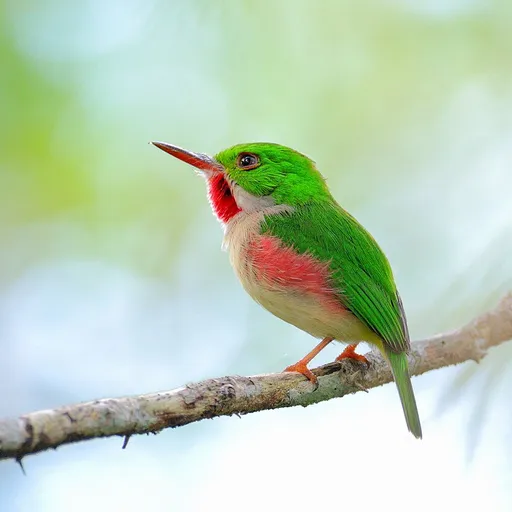
Broad-billed Tody
Todus subulatus
Least Concern
Overview
The broad-billed tody (Todus subulatus) is a small insectivorous bird endemic to the island of Hispaniola. It is the largest species within the genus Todus and is characterised by its bright green plumage, red throat, and pink flanks.
Identification
- A small, rotund bird measuring 11.5 cm in length and weighing approximately 7.5 g, with bright green feathers on the head, back, and wings.
- Distinctive markings include a plain white breast tinged with yellow, a striking red throat, pale pink flanks, and slate-coloured irises.
- Possesses the widest bill in the tody family, measuring 0.6 cm wide and 2.1 cm long, with a black upper part and an entirely red lower part.
- Vocalisations include a monotonous 'terp, terp, terp' whistle and a trilly, chattering sound when encountering predators, accompanied by a unique wing-rattling noise.
Habitat
This species is found at elevations from sea level to 1700 m, preferring arid habitats such as low-land scrubs, sub-desert areas with cacti and agave, and shaded coffee plantations. It is more prevalent in the Dominican Republic than in Haiti and rarely inhabits dense rainforests.
Diet
Broad-billed todies are insectivorous, consuming around fifty insect families including grasshoppers, crickets, and beetles, as well as specific fruits and small anole lizards. They forage primarily via an underleaf-sally technique, jumping in a parabolic arc to catch prey on the underside of leaves, and also use a sally-pounce method in dry habitats.
Did you know?
The broad-billed tody has the simplest range of frequencies of all avian vocalizations. During courtship, the male performs a 'flank display' where it puffs up its pink feathers to appear as a round green puffball, with the most attractive males extending the pink colour over their backs.
Sources
- Wikipedia · CC BY-SA 4.0
- Wikidata · CC0 1.0