
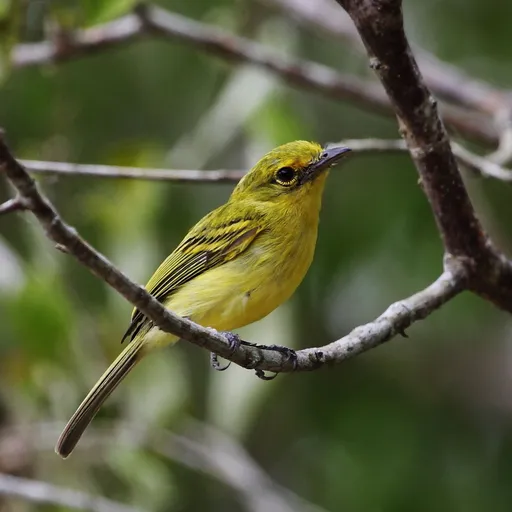
Ochre-lored Flatbill
Tolmomyias flaviventris
Least Concern
Listen
XC1107401 · Rosa Elena Albornoz @rosaelena_naturaleza · Los Caracas, La Guaira, Venezuela · CC0 1.0
Overview
The ochre-lored flatbill, also known as the yellow-breasted flycatcher, is a passerine bird in the family Tyrannidae. It is classified as Least Concern on the IUCN Red List and is considered fairly common in some regions.
Identification
- Size approximately 12 to 13 cm in length, weighing between 9 and 17.5 g.
- Plumage features a yellowish olive head with a brighter ochre-tinged stripe above the lores and eye-ring, and bright yellow underparts with an olive to ochre wash on the throat and breast.
- Possesses a wide, flat, dark gray or black bill, often with a pinkish base to the mandible, and blue-gray or black legs.
- Vocalisation consists of 3–5 loud, penetrating whistles described as 'sweeEP!' with pauses, as well as a short, mid-high rattle.
Habitat
Found from eastern Panama to Bolivia and southern Brazil, the species inhabits a wide variety of landscapes including dry to humid forests, woodlands, gallery forests, restinga, and caatinga. In the Amazon Basin, it is often found along waterways at the edge of várzea, while on Trinidad and in the Guianas it inhabits mangroves. It typically occurs in wooded habitats and can persist in relatively disturbed forests.
Diet
This flycatcher feeds on a wide variety of insects, and on Trinidad and Tobago it also consumes berries. It typically forages singly or in pairs, though occasionally joins mixed-species flocks, mostly within the forest canopy. The bird sits erect and captures prey with short upward sallies from a perch, grabbing or hover-gleaning from leaves and twigs before landing on a different perch.
Did you know?
The bird's nest is a distinctive pear-shaped bag with an entrance tube that leads up to near the bottom, constructed from rootlets, plant fibers, and sometimes moss or bryophytes. Breeding seasons vary significantly by geography, occurring in March to June in Colombia but from January to September in Suriname.
Sources
- Wikipedia · CC BY-SA 4.0
- Wikidata · CC0 1.0