
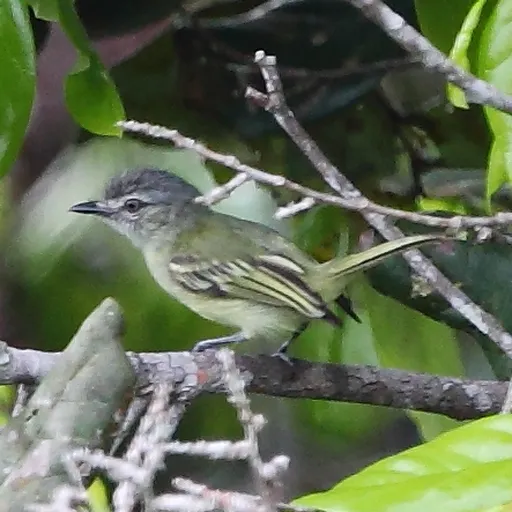
Grey-crowned Flatbill
Tolmomyias poliocephalus
Least Concern
Listen
XC249945 · Niels Krabbe · Morona-Santiago: e-slope Cord. de Cutucú: Uuntsuants, Ecuador · CC BY-SA 4.0
Overview
The Tolmomyias poliocephalus, known as the grey-crowned flatbill or grey-crowned flycatcher, is a species of bird in the family Tyrannidae. It is found throughout mainland South America, excluding Argentina, Chile, Paraguay, and Uruguay.
Identification
- Measures 12 to 12.5 cm in length and weighs approximately 11 g.
- Features a wide, flat bill with a black upper part and a dark lower part with an orange-pink base, along with gray legs and feet.
- Nominate subspecies display a mostly gray head with a whitish stripe above the lores, an olive back, and blackish wings with yellow edges forming two wing bars.
- The song of the nominate subspecies is described as a repeated, inflected, somewhat wheezy 'fiwee?', often delivered in short series or with brief pauses.
Habitat
This species primarily inhabits humid forest, including both terra firme and várzea, as well as mature secondary forest, mostly remaining in the mid-story to canopy. Its range covers most of South America, though subspecies distribution varies, with some populations found in Venezuela, Colombia, Ecuador, Peru, Brazil, and Bolivia. It generally occurs below 600 m elevation, though it can reach higher altitudes in specific regions of Venezuela and Peru.
Diet
The grey-crowned flatbill feeds on insects, though specific details are lacking. It typically forages singly or in pairs, and often joins mixed-species feeding flocks in the mid-story to canopy. It captures prey using short upward sallies from a perch, often hovering or gleaning from leaves while sitting with a horizontal pose and tail cocked.
Did you know?
Its nest is a bag that is typically suspended between 2 and 25 m above the ground and is often built near a wasp nest. The breeding season in Colombia extends from at least January to June, but the timing elsewhere is unknown.
Sources
- Wikipedia · CC BY-SA 4.0
- Wikidata · CC0 1.0