
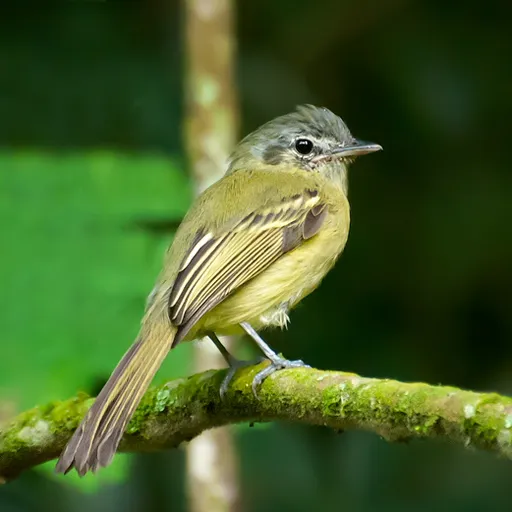
Yellow-olive Flatbill
Tolmomyias sulphurescens
Least Concern
Listen
XC923639 · JUAN ANTONIO ALONSO DE JUAN · Vereda La Máquina, Pacho, Cundinamarca, Colombia · CC BY 4.0
Overview
The yellow-olive flatbill, also known as the yellow-olive flycatcher (Tolmomyias sulphurescens), is a species of tyrant flycatcher. It is listed as Least Concern by the IUCN, with an estimated population of at least five million mature individuals across a vast range in Central and South America.
Identification
- Length of 12.5 to 14 cm with a weight of 14.5 to 15.2 g, featuring a wide, flat bill with a black upper mandible and a pale grey to pinkish lower mandible.
- Nominate subspecies display a dark olive crown, a thin white band above the lores, and a thin white eye-ring, with olive-green upperparts and a bright yellow belly.
- Wings are dusky or blackish with two yellowish-olive wing bars, and the tail is brownish to dusky with buffy edges.
- Song varies significantly by subspecies; for instance, T. s. cinereiceps produces a series of four thin, insect-like buzzes, while T. s. aequatorialis in western Ecuador sings a thin, enunciated series of quick 'psee-pset' notes.
Habitat
Found in Mexico, all Central American countries, Trinidad, and mainland South America except Chile, the bird inhabits a wide variety of forest landscapes including rainforest, montane forest, deciduous and semi-deciduous woodlands, secondary forest, and gallery forest. It typically avoids humid lowland forest and ranges in elevation up to 2,400 m in parts of Peru, though it is usually found below 1,850 m in northern Central America.
Diet
Primarily feeds on insects and also consumes small berries. It forages singly or in pairs, often joining mixed-species feeding flocks, and is characteristically sluggish, peering slowly from perches in the understory or mid-story. It captures prey by gleaning while perched, making outward or upward sallies, or occasionally catching insects in mid-air.
Did you know?
The nest is a pear-shaped bag with a sloping tube entrance constructed from rootlets, fungal rhizomorphs, grass, and spider web, often placed near a wasp nest for protection. The female alone incubates the clutch of two or three eggs, while both parents provision the nestlings.
Sources
- Wikipedia · CC BY-SA 4.0
- Wikidata · CC0 1.0