
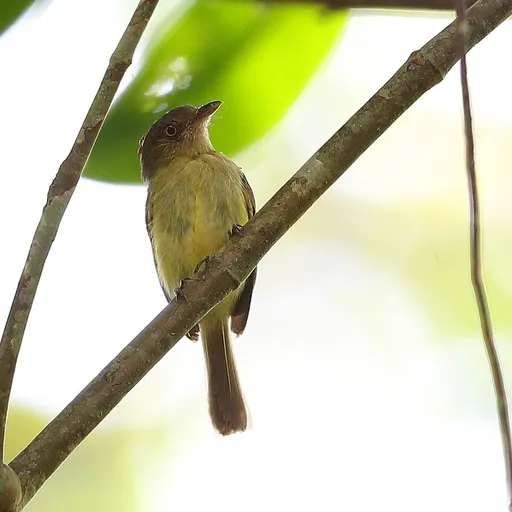
Orange-eyed Flatbill
Tolmomyias traylori
Least Concern
Overview
The orange-eyed flatbill, or orange-eyed flycatcher (Tolmomyias traylori), is a species of tyrant flycatcher found in the far western Amazon Basin. Although specimens were collected in the 1860s, the species was not formally described until 1997 and is currently considered of Least Concern on the IUCN Red List.
Identification
- Approximately 13.5 cm long with a wide, flat bill featuring a black maxilla and pale pinkish brown mandible.
- Plumage includes a cinnamon forecrown, olive-gray back, and bright yellow belly, with whitish buff throat and chin.
- Distinguishing features include pale orangish brown or yellowish mauve irises and bluish gray legs.
- Song consists of a rising series of short, raspy whistled notes described as 'zreee' and 'zreeep', often becoming squeaky at the end.
Habitat
This species inhabits riverside forest, particularly seasonally flooded várzea, within the far western Amazon Basin ranging from southern Colombia through eastern Ecuador to northern Peru. It primarily occurs in the mid-story to canopy of the forest and is known along the Napo River in Ecuador and north of the Amazon in Colombia.
Diet
The orange-eyed flatbill primarily feeds on insects, capturing prey by making outward or upward sallies to snatch them from leaves. It typically forages singly or in pairs and regularly joins mixed-species feeding flocks.
Did you know?
Despite first specimens being collected in the 1860s, the bird was not recognised as a distinct species until the 1980s and was not formally described until 1997, honouring ornithologist Melvin Alvah Traylor Jr.
Sources
- Wikipedia · CC BY-SA 4.0
- Wikidata · CC0 1.0