
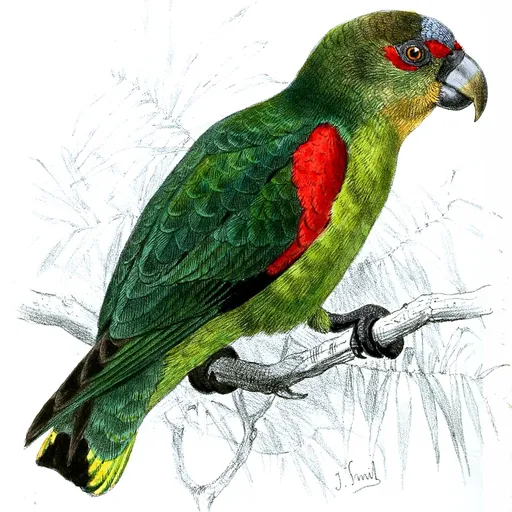
Blue-fronted Parrotlet
Touit dilectissimus
Least Concern
Overview
The blue-fronted parrotlet (Touit dilectissimus) is a species of bird in the family Psittacidae, commonly known as the African and New World parrots. It is assessed as Least Concern on the IUCN Red List, though its population is believed to be decreasing.
Identification
- Measures approximately 17 to 18 cm in length and weighs 59 to 71 g, with a body that is mostly green and darker above than below.
- Features a distinctive blue forehead, a white eye ring, and a red line in front of and below the eye with additional blue beneath it.
- Displays much red on the wing's 'wrist', black primaries with green outer edges, and yellow underwing coverts.
- Males exhibit more red on their wings than females, while immatures resemble females with a less distinctive facial pattern.
Habitat
Found in eastern Panama, along the Pacific slope of Colombia and Ecuador, and in the Andes and Serranía del Perijá of Venezuela. It inhabits cloudforest and mature secondary forest, typically ranging in elevation between 500 and 1,400 m, though it can occur from as low as 100 m up to 3,000 m.
Diet
Little is known about its diet, but stomach contents have included small fruits and seeds from the family Clusiaceae. It remains unclear whether the bird targets the fruit pulp or the seeds when feeding on these fruits.
Did you know?
These parrotlets are often overlooked because they are quiet while feeding and roosting in tree canopies, yet they can become very noisy when in flight, resulting in a continuous chattering sound from the flock.
Sources
- Wikipedia · CC BY-SA 4.0
- Wikidata · CC0 1.0