
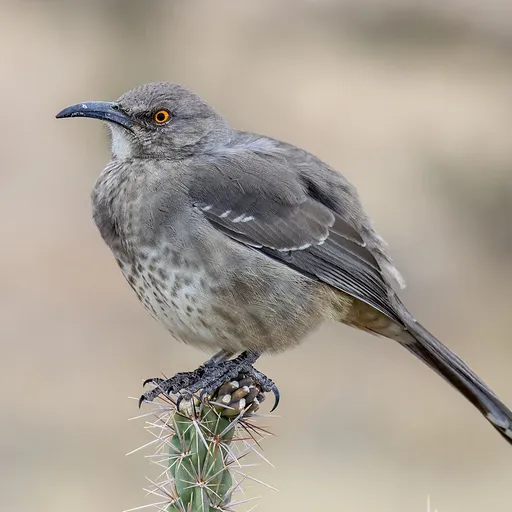
Curve-billed Thrasher
Toxostoma curvirostre
Least Concern
Overview
The curve-billed thrasher, Toxostoma curvirostre, is a medium-sized mimid native to most of Mexico and the deserts of the southwestern United States. As a non-migratory species, it is the most common desert thrasher throughout much of its range, classified as Least Concern by the IUCN Red List despite a declining population.
Identification
- Medium-sized bird (27–28 cm) with a compact body, large head, short wings, and a long tail.
- Distinctive sickle-shaped, brownish-black bill that is nearly as long as the head width, with both mandibles curved.
- Grey-brown plumage with a chest featuring circular brown-grey spots; eyes are typically orange, shading to golden in adulthood.
- Known for an abrupt and brash 'whit-wheet' call and songs resembling the northern mockingbird, often sung from high perches.
Habitat
Found in desert regions of the southwestern United States and most of Mexico, ranging from sea level to 3,000 m. It favours areas with cholla and saguaro cacti, ocotillo, mesquites, palo verde, and creosote bushes, but can also inhabit woodland edges and suburban environments with adequate vegetation. Its distribution spans from Arizona and New Mexico to west Texas, southeastern Colorado, and southwestern Kansas in the US, and across much of Mexico.
Diet
An omnivore that forages primarily on the ground, digging holes deeper than 5.1 cm to find invertebrates such as beetles, moths, arachnids, and snails. It also consumes vegetable matter, including cactus fruits, hackberries, and anacua, and sips nectar from saguaro blossoms, acting as a pollinator. The species will even consume dog food, occasionally feeding it to its chicks.
Did you know?
The curve-billed thrasher is known in Mexico as cuicacoche, meaning songbird, due to its extensive repertoire of melodies and ability to mimic species such as the scissor-tailed flycatcher, northern cardinal, and pyrrhuloxia. Males display vigorous courtship behaviour, engaging in physical combat with rivals involving purring, hissing, and strutting before copulation.
Sources
- Wikipedia · CC BY-SA 4.0
- Wikidata · CC0 1.0