
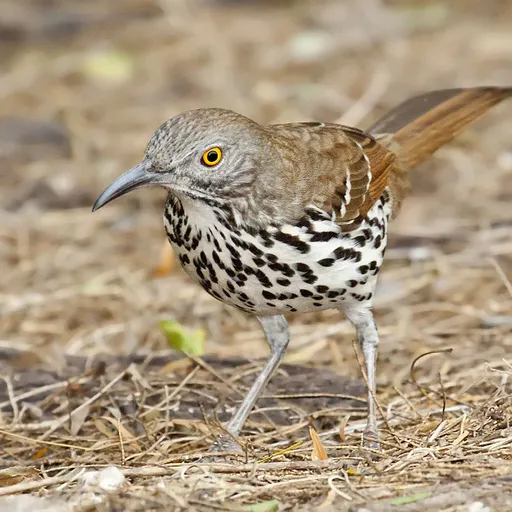
Long-billed Thrasher
Toxostoma longirostre
Least Concern
Overview
The long-billed thrasher (Toxostoma longirostre) is a medium-sized resident songbird found in South Texas and eastern Mexico. It belongs to the thrasher family and is closely related to the brown thrasher, though the two species do not typically overlap in range except during winter migrations.
Identification
- Slender and long-tailed, averaging 26.5–29 cm in length with a grayish-brown crown and rufous back, rump, and shoulders.
- Underparts are white or pale-buffy, marked with keenly blackish oval shapes on the chest and belly, paired with orange or orange-yellow eyes.
- Possesses a long, dull brown bill that is blacker than its relative's, with a pinkish-grey base on the lower mandible.
- Song is described as rich and musical, often warbling with phrases repeated two to four times, accompanied by calls like a loud 'cleeooeep' or 'tweeooip'.
Habitat
This species is a permanent resident in southern Texas and north-western Mexico, with its range extending to central Veracruz and eastern Coahuila. It prefers habitats with dense vegetation, particularly spiny shrubs and trees such as thornbushes, willows, mesquite, and cacti. While it has expanded its range northwards in Texas likely due to climate change, it remains a common resident within its established territory.
Diet
The bird forages on the ground by rapidly sweeping its bill from side to side to toss leaf-litter, a behavior known as 'thrashing', and also scratches the ground. Its diet primarily consists of invertebrates including grasshoppers, beetles, insects, crustaceans, and gastropods, supplemented by vegetable matter such as berries.
Did you know?
Despite being generally not wary, the long-billed thrasher is a staunch defender of its territory and will defend its nest ferociously, including against human intruders.
Sources
- Wikipedia · CC BY-SA 4.0
- Wikidata · CC0 1.0