
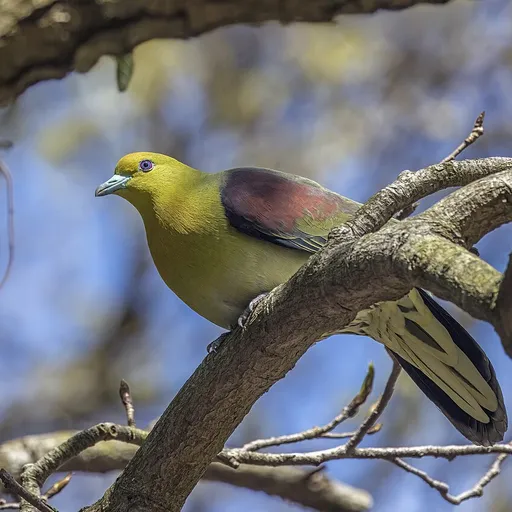
White-bellied Green Pigeon
Treron sieboldii
Least Concern
Overview
The white-bellied green pigeon, also known as Siebold's green pigeon, is a medium-sized species in the family Columbidae found in East and Southeast Asia. It is one of the few green pigeons that migrates, with populations in Hokkaido being wholly migratory and present only from May to September.
Identification
- Medium-sized, compactly built pigeon measuring 33–36 cm long.
- Males feature a bright green head and chest, olive wings, maroon shoulder patches, and a white belly; females are less colourful, lacking the maroon patches and having a frosted green breast.
- Distinctive light bluish bill with a grey tip, vivid blue eye rings, and pink to violet irises.
- Feet are red to violet, matching the white legs and belly.
Habitat
This forest-dwelling bird settles in temperate deciduous and mixed forests, preferably primary ones, ranging from lowlands to mountain forests up to 1,400 m. Its range includes Japan, Taiwan, eastern and southern China, and northern Southeast Asia, specifically northern Thailand, Laos, and Vietnam.
Diet
The species exclusively eats fruit, such as Korean cherry cherries, crimson glory vine grapes, and dogwood berries, switching to acorns in winter. They mostly pick fruit from branches and occasionally descend to the ground to drink water.
Did you know?
These pigeons have the unusual habit of drinking saltwater, which scientists believe aids in the digestion of acidic berries. In Japan, they are known to form large flocks of up to 440 individuals at coastal drinking sites during summer.
Sources
- Wikipedia · CC BY-SA 4.0
- Wikidata · CC0 1.0