
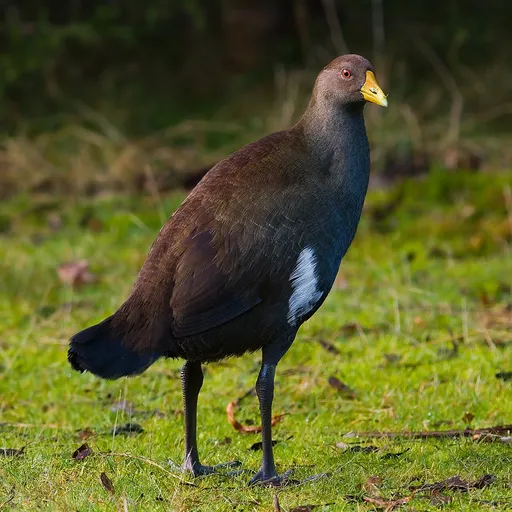
Tasmanian Nativehen
Tribonyx mortierii
Least Concern
Overview
The Tasmanian nativehen (Tribonyx mortierii), also known as piyura, is a flightless rail endemic to Australia's island state of Tasmania. It belongs to the Rallidae family and is one of twelve bird species found exclusively in this region.
Identification
- Stocky bird between 43 and 51 cm long with olive-brown upperparts and a white patch on the flank.
- Dark underparts with a bluish-grey tinge and a short, erect tail that is close to black.
- Bright red eyes, thick grey scaly legs, and a bill with a small greenish-yellow frontal shield.
- Vocalisations include 14 calls ranging from low grunts to high-pitched alarms, as well as a see-sawing duet that rises to a crescendo of harsh screeching.
Habitat
Endemic to and widespread in Tasmania, except for the west and south-west regions, and absent from King Island. It inhabits open grassy areas close to water, where it is generally common and easily seen around bodies of water with grassy verges. A population introduced to Maria Island is now well established.
Diet
Primarily grazes on grass shoots and the leaves of low herbs during daylight hours, supplemented by insects, seeds, and orchard fruit. As a secondary grazer, it relies on other species, such as rabbits, to keep grass swards low and provide fresh shoots, which has contributed to its population growth following European settlement.
Did you know?
Despite being a member of the rail family, the species is locally nicknamed 'turbo chook' due to its ability to run at speeds of up to 35 kilometres per hour, using its wings to balance.
Sources
- Wikipedia · CC BY-SA 4.0
- Wikidata · CC0 1.0