
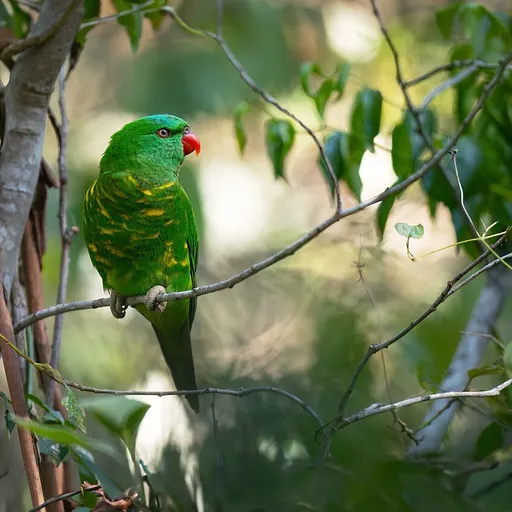
Scaly-breasted Lorikeet
Trichoglossus chlorolepidotus
Least Concern
Overview
The scaly-breasted lorikeet (Trichoglossus chlorolepidotus) is an Australian bird species classified as Least Concern on the IUCN Red List. It is commonly found in woodland areas across eastern Australia and is well known for its distinctive yellow breast feathers that are broadly edged with green, creating a scaled appearance.
Identification
- Approximately 23 cm in length with emerald-green head plumage tinged with blue and yellow breast feathers edged with green to create a scaly pattern.
- Features orange-red eyes, dark coral-red bills, and grey-brown legs, with orange-red markings at the base of the outer tail feathers and underwing coverts.
- Produces a metallic, rolling, continuous screech in flight and a shrill chatter while feeding, making it audibly noticeable despite its green camouflage.
Habitat
This species is distributed in most timbered areas of eastern Australia, ranging from Bamaga in North Queensland to the Illawarra district in New South Wales. It generally prefers coastal plains and adjacent tablelands, favouring open, lightly timbered areas and melaleuca thickets, though it occasionally appears along watercourses west of the Great Dividing Range and in urban gardens.
Diet
Feeding habits are similar to the rainbow lorikeet, with a diet primarily consisting of nectar from trees such as broad-leaved paperbark, along with pollen, blossoms, berries, and insects. The species also consumes cultivated fruits, sometimes causing damage in orchards, and raids sorghum and maize crops for unripe grain.
Did you know?
The bird's predominantly green plumage blends so effectively with foliage that observers standing beneath a tree may struggle to spot the birds, often identifying their location only by the dark coral-red of their beaks.
Sources
- Wikipedia · CC BY-SA 4.0
- Wikidata · CC0 1.0