
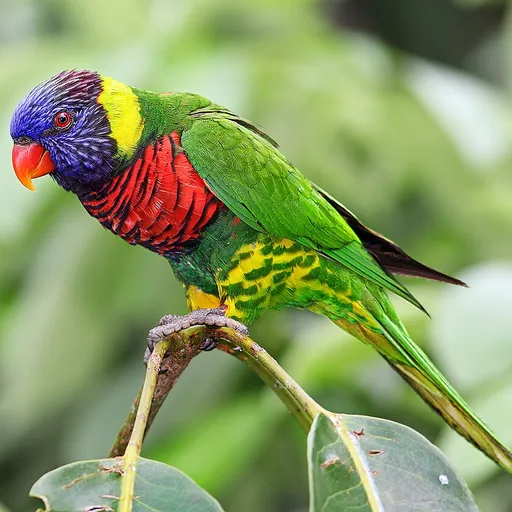
Coconut Lorikeet
Trichoglossus haematodus
Least Concern
Overview
The coconut lorikeet, also known as the green-naped lorikeet, is a parrot in the family Psittaculidae belonging to the 'rainbow lorikeet' species complex. It is a species of least concern that was previously lumped with several other distinct species.
Identification
- Measures 25–30 cm in length with an orange-red bill and a head that is clear blue, fading to brown at the neck.
- Features a yellow collar and green upperparts, with a red breast that may show blue-black barring and a tail barred in green and yellow below.
- Males have bright red irises, while females have orange-red irises, though this difference is slight and unreliable for sexing single birds.
- Young birds are distinguishable by their lack of bright neck, breast, and belly coloration, appearing duller and smaller overall.
Habitat
Found from Maluku in easternmost Indonesia across New Guinea and the Bismarck Archipelago to the Solomon Islands, Vanuatu, and New Caledonia. It occupies lowland and wooded hill habitats, including mangroves, rainforests, swamps, and human-modified areas such as coconut plantations and gardens, reaching altitudes of up to 2,440 m.
Diet
Feeds mainly on nectar and pollen using a specialized tongue with a small brush of extended papillae, though it also consumes seeds, fruits, berries, insects, and larvae. It often forages in very large bands, making significant noise with screeching calls during flight.
Did you know?
The scientific name Trichoglossus haematodus translates literally to 'bloody hair-tongue', a combination of the Ancient Greek words for hair, tongue, and blood-red. This specific epithet was derived from the blood-red coloration of the bird's bill and breast.
Sources
- Wikipedia · CC BY-SA 4.0
- Wikidata · CC0 1.0