
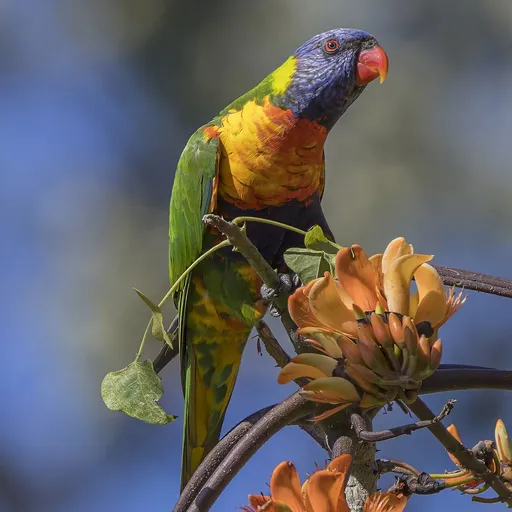
Rainbow Lorikeet
Trichoglossus moluccanus
Least Concern
Overview
The rainbow lorikeet is a medium-sized parrot found in Australia, classified as of least concern by BirdLife International. It is the most commonly observed bird in the country, though it is considered a pest in certain regions where it competes with native species.
Identification
- Medium-sized parrot ranging from 25 to 30 cm in length, including the tail.
- Deep blue head with a greenish-yellow nuchal collar and green wings, back, and tail.
- Orange-yellow chest and deep blue belly, with green thighs and rump.
- Yellow wing-bar and red underwing coverts visible in flight.
- Juveniles have a black beak that gradually brightens to orange in adults.
Habitat
Found along the east coast of Australia from northern Queensland to South Australia, the species inhabits forest, shrubland, wetlands, and some artificial habitats. It has also established feral populations in Perth, Western Australia, Tasmania, Auckland, New Zealand, and Hong Kong.
Diet
Feeds mainly on fruit, pollen, and nectar, possessing a tongue with a papillate appendage adapted for gathering pollen and nectar. Important nectar sources include eucalyptus, Pittosporum, Grevillea, and Spathodea campanulata, while coconuts are significant in Melanesia. The species also consumes fruits from Ficus, Trema, and Muntingia genera, and may raid crops such as apples, maize, and sorghum.
Did you know?
Rainbow lorikeets do not have immediately discernible dimorphic traits, meaning males and females look identical and require surgical sexing or DNA analysis to distinguish between them.
Sources
- Wikipedia · CC BY-SA 4.0
- Wikidata · CC0 1.0